


Teaching Tips & Tricks, Podcast Articles | Oct 19, 2025
4 routines to help students notice and adjust their thinking

By Angela Watson
Founder and Writer
4 routines to help students notice and adjust their thinking
By Angela Watson
Metacognition — “thinking about your thinking” — is one of the most powerful skills we can teach students, and it doesn’t require adding anything new to your already packed schedule.
In this article + Truth for Teachers podcast episode, you’ll learn four simple, one-minute routines you can weave into your daily classroom flow to help students notice, analyze, and adjust their own thinking.
Listen to episode 336 below,
or subscribe in your podcast app
Sponsored by Listenwise and Mia and Tiago Books
How to teach kids what metacognition is and how it can help them
Metacognition is really about two things: awareness and adjustment.
Awareness means noticing what’s happening in your mind and body:
- “I’m feeling distracted right now.”
- “I don’t understand this yet.”
- “My brain feels tired.”
Adjustment means taking action in response to that awareness:
- “I’m going to move to a quieter spot so I can focus.”
- “I’m going to try a different strategy for this math problem.”
- “I’m going to take a short break and then come back.”
When students can do both — notice and adjust — they become more self-directed. They need less micromanaging from us because they’ve learned to monitor themselves.
But of course, children don’t come in knowing how to do this. Even older students might never have been explicitly taught it.
In my K–2 curriculum, I make these concepts concrete by introducing four “Brain Helpers”:
- 🦉 Wise Owl — Prefrontal cortex: helps with smart choices and problem-solving
- 🐶 Guard Dog — Amygdala: warns you when you feel scared, upset, or distracted
- 🐘 Librarian Elephant — Hippocampus: stores your memories and facts
- 🐿️ Acrobat Squirrel — Cerebellum: helps with movement, balance, and energy
For a 6-year-old, asking, “Is your Guard Dog barking?” can be easier than asking, “Are you feeling emotionally reactive and allowing it to affect your focus?” The metaphor gives them distance and a shared language.
If you teach older students, you can take that same idea of “noticing your brain at work” and introduce them to the concept of being both the watcher and the director of their thoughts.
Beginning at the middle school level in my Finding Flow curriculum, I introduce the term “metacognition” and the idea of being the watcher of your thoughts. Later, we work on being the director of your thoughts.
So we’re telling students, “Metacognition is like having a conversation with yourself about your own thinking processes. You’re not just doing things — you’re thinking about how you’re doing them.”
You can say:
- “Your mind is like a movie theater. The movie playing is made up of your thoughts — scenes from today, memories from the past, worries about the future.”
- “When you’re the watcher, you’re in the audience. You’re just observing what’s happening on the screen, without judging if the scene is good or bad. You might notice, ‘Wow, my mind is really focused on this one thing,’ or, ‘I’m jumping between lots of thoughts right now.’”
- “When you’re the director, you step into the control room. You can say ‘Cut!’ on a negative scene. You can choose what comes next. You can rewrite the script so your mental movie takes a more positive or productive turn.”
This is such a powerful shift for older students because it’s about self-awareness and self-agency. You’re not just a passive observer of your thoughts — you can also choose to direct them in a way that serves you better.
So now that we’re clear about what metacognition is and developmentally appropriate ways to explain it to students, I’ll share the 4 quick routines you can use to help students build metacognitive skills.
Routine #1: The Attention Check
This is a quick, 30-second pause where we all check in on our focus.
Teach students to think of focused attention as a flashlight. There are many different objects in a room, but wherever you shine the flashlight is where the light is focused.
Many times our flashlight of attention feels like it’s swinging all over the place: the task at hand, our phones, the noise in the hallway, the person next to us who’s talking, and so on .It’s more like swing lights on a concert stage than a flashlight. Learning to focus your attention is like learning to control the direction of the flashlight. It’s choosing which things to illuminate, light up, and bring attention to, and which to leave in relative darkness.
Directing your attention requires control, and that requires practice. The more that you practice shining the flashlight of your attention in one spot and holding the flashlight there, the easier it becomes to do it again.
We can introduce this imagery to students and teach specific strategies for what to do when they’re trying to focus their attention and the mind wanders. The approach I teach is this:
- Notice that it’s happening. This is a good thing! Sometimes we’re not even aware that our thoughts have wandered.
- Observe, don’t judge. Critical thoughts might pass through your mind, but don’t focus on them. There’s nothing wrong with you if you’re getting distracted.
- Bring your thoughts back to the thing you want to focus on.
Repeat this process as many times as necessary.
So, for the quick check-in routine, you can ask, “Where is your flashlight of attention pointing right now?”
For little learners, you can ask, “Is your Wise Owl holding it steady, or is your Guard Dog pulling it somewhere else?” The kids can physically point their pretend flashlights — sometimes at their book, sometimes at the ceiling, sometimes at the friend sitting next to them.
For older kids, you can strip away the animal metaphors and just say: “Where’s your mental spotlight right now? Is it on the task, or somewhere else?” Follow up with: “If it’s somewhere else, what’s one thing you can do to bring it back?”
Here’s the key: This is not about catching them doing something wrong. It’s about noticing. Even if they’re distracted, noticing is step one toward regaining focus.
Over time, students begin doing these checks without you prompting them to do so. And that’s the goal — they don’t just drift for 15 minutes before realizing it. They catch themselves, and they choose to come back.
Routine #2: Brain Break Signals
The second routine is about helping students connect their physical state to their ability to focus — because focus isn’t just a mental skill. It’s deeply tied to the body.
When our bodies are restless, stiff, or drained of energy, our ability to concentrate plummets. Most students don’t consciously notice when that’s happening. They just try to push through, even though their brain would work much better with a quick physical reset.
That’s where Brain Break Signals come in.
For K–2, I make it playful by tying it to the 🐿️ Acrobat Squirrel, who’s in charge of movement, balance, and coordination. I’ll say:
“Check in with your Acrobat — is it ready to sit and focus, or does it need a quick wiggle?”
If a lot of kids signal they need a break, we take 20–30 seconds to stretch, hop in place, do chair twists, or even a quick “pretend to be your favorite animal” challenge. The goal is to get blood flowing and wake up the brain before we dive into the next task.
For older students, you can drop the animal metaphor and call it an energy check. Thumbs up if they’re alert, sideways if they’re fading, down if they’re drained. If I see a lot of sideways or down thumbs, we take a reset moment — stand, stretch, refill water bottles, or do a 30-second breathing exercise.
I’ve mentioned in episode 314 about how to use movement to increase work quality, focus, and creativity that I like allowing students to choose when to take breaks and what kind of break. That’s because if you as the teacher are determining when the break is needed and telling students what to do during the break, we’re skipping the metacognitive practice. Ultimately we want students to self-monitor, not to depend on an adult to tell them when to work and when to take a break.
As students get used to the Brain Breaks Signal routine, you can build in self-selected micro-breaks so they don’t all have to stop at the same time. Here’s how to make that work:
- Teach each type of break explicitly — practice them together so students know what they look and sound like.
- Post a Brain Break Menu — a small chart on the wall with 3–4 quick options. For example: movement breaks (jumping jacks, wall push-ups, marching in place, or a 20-second dance party); stretch breaks (overhead reach, side bends, shoulder rolls, neck stretches); breathing breaks (“smell the flower, blow the candle” breaths for K–2, box breathing for older grades); sensory breaks (squeeze a stress ball, trace a shape on your desk, use a fidget for 20 seconds); and micro social breaks (turn to a neighbor and share the most interesting thing you’ve learned today in one sentence)
- Use a quiet signal — a small hand raise or “two fingers up” means “I’m taking a micro-break” without interrupting the class.
- Set parameters — e.g., no more than 30 seconds, stay in your area unless you’re getting water, and choose a break that doesn’t distract others.
- Gradually release responsibility — at first, you might lead the breaks for everyone. As routines stick, let students self-monitor and choose their own when they notice their energy fading.
When this works well, you might have one student standing to stretch while another quietly takes a deep breath, and the rest keep working. No one’s off-task — they’re just managing their brain state in real time.
So you could use language like this to introduce the idea:
“In our classroom, we know that our brains work best when our bodies are ready to focus. Sometimes our Acrobat Squirrel (or energy level) needs a quick reset. That’s what brain breaks are for. A brain break is not playtime. It’s a short, intentional activity to help you get your focus and energy back so you can do your best work. Here’s how we agree to use brain breaks in this class:
- Choose the right break for you — movement, stretch, breathing, or quiet fidget.
- Keep it short — no more than 30 seconds.
- Stay in your space — unless you’re getting water.
- Be respectful — choose a break that won’t distract others.
- Come right back to learning — the goal is to feel more focused than before.”
You can even use call and response to seal the agreement:
Teacher: “Why do we take brain breaks?”
Students: “To help our brains focus!”
Routine #3: Mistake Moments
The idea is simple: when something goes wrong, we pause. Not to dwell on the mistake, not to beat ourselves up, but to name what our brain can learn from it.
That pause is powerful. It gives students a moment to shift from an emotional reaction — frustration, embarrassment, giving up — into curiosity and problem-solving.
At the elementary level, you connect this directly to the Brain Helper Team:
- “What can our 🦉 Wise Owl learn from this?”
- “How will our 🐘 Librarian Elephant file this away for next time?”
We might role-play how the Wise Owl pauses, thinks about what went wrong, and then tries again. Or how the Librarian Elephant carefully “files” the memory of what didn’t work so we can make a better choice later.
The key here is making mistakes feel normal and even a little bit fun to talk about. We’ll sometimes share “favorite mistakes” at the end of the day — a moment where we learned something unexpected because we tried and it didn’t work the first time.
For secondary students, you can use reflection questions:
- “What was your plan?”
- “Where did it break down?”
- “What will you try differently next time?”
For example:
“You started your science lab with one hypothesis. It didn’t turn out as expected. What happened? Where was the gap? What could you change if you ran the experiment again?”
Or:
“You misread part of the word problem on the test. What can you do next time to make sure you catch that?”
Now, I’m guessing you’re already doing this naturally with students–having them reflect back on what went wrong and how to fix it.
The shift here is in using it to start building a metacognitive loop: notice → analyze → adjust.
We want students to do that naturally: notice things went off track, analyze why, and adjust accordingly. We don’t want them waiting for an adult to point out the mistake and ask questions or provide direction. We want this metacognitive practice to be ingrained.
Over time, you’ll hear their self-talk shift. When students get in the habit of having a Mistake Moment, they begin to see mistakes as data rather than as personal failures. Instead of “I’m bad at this,” they start thinking, “I learned that this strategy doesn’t work well for me — I’ll try another.”A student who used to crumple up a paper in frustration might now say, “I’m going to redo this part and see if I can make it better.” That’s the payoff.
Tips for making this a routine:
- Model it yourself — Share when you’ve made a mistake in teaching and how you’re adjusting.
- Keep it short — A Mistake Moment can be 30 seconds.
- Normalize it daily — The more you do it, the less students see mistakes as a big deal.
- Make it safe — Avoid sarcasm or tone that could make students feel ashamed of their errors.
So at the kindergarten level, you might model this self-talk by saying, “We forgot to line up quietly the first time. What can we try next time so it works better?” In fifth grade you could say, “Our first attempt at the group presentation went over time. How can we adjust so we stay under the 3-minute limit?” At the high school level, the self-talk you model might be, “We lost points on the project for missing a requirement. How can we make sure we catch that before turning it in next time?”
Routine 4: End-of-Class Brain Check
The final routine is the End-of-Class Brain Check — but instead of the generic “What did you learn today?” I want you to think of this as a metacognition wrap-up, where students reflect not just on what they learned, but how they learned it, what helped them, and how they might approach things differently next time.
This isn’t about testing recall. It’s about building an ongoing awareness of the mental tools and strategies they used — so they can start choosing those tools on purpose in the future.
For young learners, I link it directly to the Brain Helper Team. The prompts change daily so it stays fresh, but they always circle back to “Who helped your brain most today?”
Some examples:
- “What’s one thing your 🦉 Wise Owl learned today?”
- “When did your 🐶 Guard Dog help you feel safe or calm down?”
- “When did your 🐿️ Acrobat Squirrel give you energy to keep going?”
- “What will your 🐘 Librarian Elephant remember for tomorrow?”
You might rotate through one Brain Helper per day, or let students pick the helper that was most active for them. If you have time for more sharing, ask a few students to explain why they chose that helper — the “why” is where the metacognitive reflection lives.
For older kids, still keep it focused on process over content:
- “What’s one strategy that helped you learn something today?”
- “When did you lose focus, and how did you get it back?”
- “What will you try differently next time you do something similar?”
You can also add more advanced metacognitive prompts, like:
- “What was one obstacle you overcame today?”
- “How did your emotions affect your focus?”
- “What did you learn about yourself as a learner?”
What elevates this from a routine check to a real metacognitive habit is consistency and intentionality. Here are a few ways to make it stick:
- Build it into the closure — do it at the same time each day so it becomes automatic.
- Make it multimodal — sometimes oral, sometimes written, sometimes a partner share.
- Use a visible tracker — keep a class chart of “brain helpers in action” or “strategies we used” so patterns emerge over time.
- Connect it to tomorrow — end by asking, “How can we use what we noticed today to make tomorrow’s learning even better?”
Putting it all together
This End of Class routine closes the loop on all the other ones:
- The Attention Check tells us where our focus is now.
- Brain Break Signals keep our bodies aligned with our focus.
- Mistake Moments help us adjust when things don’t work.
- And the End-of-Class Brain Check makes us step back and notice the whole picture — so we can carry those insights forward.
When you use these consistently, you’re not just managing the learning process for your students — you’re teaching them to manage it for themselves.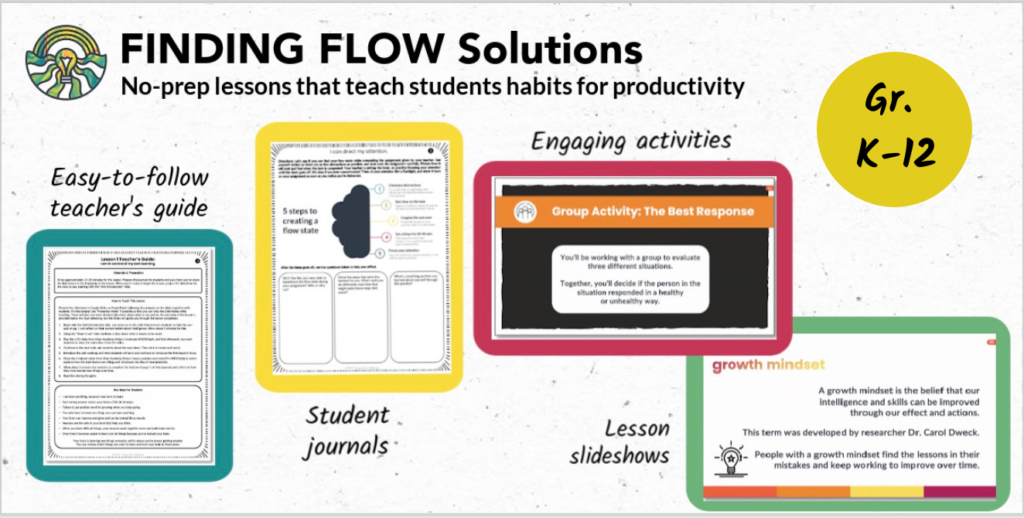
If you want a ready-made way to introduce these ideas to your students, my Finding Flow Solutions curriculum is designed to do exactly that — and it’s for grades K–12.
Each unit gives you everything you need to teach these skills without adding to your workload:
- No-prep, editable slideshows that walk you and your students step-by-step through the lesson.
- Student journals with prompts that help kids reflect on their own learning process and apply it.
- A teacher’s guide with the key ideas, suggested language, and discussion prompts so you can feel confident guiding the conversation.
We cover topics like how to focus and get into the “flow zone,” how to train your brain to bounce back after mistakes, how to use movement to sharpen concentration, and how to build self-awareness about your own thinking.
And here’s the best part — there’s free downloadable sample lessons for every grade level so you can try it with your students before committing. I’ll link that in the show notes so you can grab yours today.
Remember, metacognition isn’t something we teach once — it’s a way of learning that students carry into every subject, every grade level, and every stage of life. When you build simple, consistent routines for noticing and adjusting thinking, you’re giving students the tools to take charge of their own learning.
The Truth for Teachers Podcast
Our bi-weekly podcast has received over 1,200 five star ratings + 9 million downloads. You can support our work by subscribing in your favorite podcast app for free!
Explore all podcast episodes


Angela Watson
Founder and Writer
Sign up to get new Truth for Teachers articles in your inbox
OR

Join our
community
of educators
Share ideas or get advice via our social channels.


