


Classroom Management, Podcast Articles | Jul 13, 2025
How a daily binder routine teaches students the skills behind academic success

By Angela Watson
Founder and Writer
How a daily binder routine teaches students the skills behind academic success
By Angela Watson
What if teaching students how to get and stay organized could unlock their full academic potential?
In this article + podcast episode, I’m talking with Mitch Weathers, who calls this “studentness.”
 Mitch is a veteran teacher and the creator of a classroom routine called Organized Binder.
He has developed a really simple, sustainable way to support kids with executive functioning—and it doesn’t involve adding more to your plate. His approach is built around a physical binder, but the real power is in the daily routine that teaches students how to manage their time, tasks, and materials.
I think you’ll find practical strategies you can use right away, whether you’re teaching elementary, middle, or high school…and whether you use paper, digital tools, or a mix of both.
Listen to episode 329 below,
or subscribe in your podcast app
Sponsored by Educate and Rejuvenate
How executive functioning skills underlie academic success
ANGELA: So Mitch, for teachers who are new to the concept of executive function, what are the core principles they should know about how it impacts student success?
MITCH: That’s a good question. And I try to stay away from overly academic-sounding definitions of executive functioning.
I talk about this in my book as well, but there’s a school that coined this phrase, “studentness.” They reached out and said, “We’ve committed to developing studentness in our students.” They really want to equip kids with the foundational skills needed to access any content. These are the skills that set the foundation for learning and support the content we’re teaching.
When we look at what really sets students up for academic success, it’s not just the content. I’m not saying the things we teach aren’t important, but it’s an order of operations. Developing executive functioning skills—or this sense of studentness or student agency—is primary. The stuff we’re teaching comes after.
The challenge is that in the classroom, we don’t always have the luxury of that order. I still have to teach fifth-grade math or ninth-grade science. So I have to find a way to honor the order of operations, but do it concurrently with the content. That’s where the idea of studentness comes in. It’s about helping students not only understand what they’re learning, but how to jump into their learning with agency and flexibility.
For me as a learner, I never really felt that. I often felt like a passive participant in my education. Paulo Freire talks about the idea of being a passive object in your education instead of an active subject. If we can help students become active subjects, then the learning is truly theirs. They know how to engage. That’s where executive functioning and studentness come in.
It does. And I see what you mean about the jumping in. I feel like it’s a really good phrase to think about because that’s one of the issues that we see a lot in classrooms, is that kids hold back. They want the hand-holding.
They need everything explained to them individually.
Right.
“How do I get started? What do I do next? Now what?” You’re tying it into that.
And some of that comes from fear of failure. But often, it’s just, “I don’t know how.”
If you watch students, you’ll sometimes see them looking around the room thinking, “Everyone else seems to know what to do, and I don’t.” But when they get repeated practice with executive functioning skills and begin to own them, that sense of agency starts to develop.
Organization is a key part of executive functioning skills
How does organization tie into this?
Oh gosh, it’s foundational. Picture the overstuffed backpack or the desk crammed with papers. When students learn how to get and stay organized—and I emphasize that distinction—they experience a sense of calm.
I had a student who was totally committed to being disorganized. She just would not follow any of our routines. One day I finally said, “Let’s just take your stuff and organize it together using the class sample binder.” Within ten minutes, she had everything put back together. When I walked over to check on her, she looked up at me, patted her chest, and said, “Mr. Weathers, I actually feel better.”
That moment was so powerful. There’s something grounding about being organized. Once you are, you feel better. You’re more efficient. You’re more effective. You tend to enjoy your work more. That’s especially true with learning. Organization supports task initiation and task completion. If I know where my materials are and I’m accountable for them, I’m more likely to follow through. And that spills over into other skills like self-monitoring and self-regulation.
Organization might actually be the best place to start when it comes to developing executive functioning skills.
I relate to that. Some people can’t even focus if they’re in a messy environment. I have a friend who can’t cook unless the kitchen is clean first.
Not everyone’s brain works like that, but it’s true that even those who don’t “need” organization still benefit from it. Things are easier to find, and you’re not wasting time searching for materials.
Absolutely. And I want to emphasize what you said about individual learning styles. Some people do make a mess while they work, and that’s okay. But if they know how to reset and get back to a clean starting place, there’s empowerment in that. Knowing how to return to an organized state is a valuable skill. That’s what we want to help students develop.
So let’s get into what that looks like in the classroom. How can we as educators create an environment that supports the development of executive function skills, especially for kids who struggle with organization?
Yeah. First, let’s say this loud and clear: executive dysfunction is real. And you can see it. That’s one reason I like starting this work in the analog world—because you can actually see the disorganization. That messy book bag? It’s a gift. It’s visible evidence we can respond to.
The key word is environment. Executive functioning skills aren’t taught the same way we teach math or reading. They’re best learned through modeling and daily practice. Over time, students begin to internalize the skills and make them their own.
Paul Tough, in How Children Succeed, says that if we can shape environments in ways that support executive functioning, we set kids up for success. So when I talk with educators, I ask: what’s the environment you’re shaping? It could be a classroom, a bus, a front office, or a district. What changes can you make to help students practice these skills?
Let’s talk first about general classroom management and environment, then we’ll get into the notebook.
Perfect. So here are three key components: clarity, modeling, and routine. If I’m a fifth-grade teacher with a lot of curriculum to cover, time is tight. I might want to build executive functioning, but when? That’s why I advocate for embedding it into your routine.
Start by clearly modeling what you expect. If we’re focusing on organization, have a class sample. Keep it updated daily. Let students reference it.
Then establish a predictable routine. The subtitle of my book is “Creating Safe and Predictable Learning Environments.” I really believe in the power of predictability—especially for students whose lives outside of school might be chaotic.
When a student enters a predictable classroom, it lowers their anxiety. Their affective filter goes down, and they’re more open to learning. If our daily routines are consistent—how we start class, how we transition, where we put our materials—students get repeated practice with executive functioning skills. And they do it while engaging with the content.
That’s the key: it’s embedded. It’s not something extra. It’s part of what we’re already doing. It’s sustainable, and it has a small time footprint.
How is that different from what teachers might already be doing? Because I feel like routines and consistency are things most teachers have heard before. But what you’re describing is more intentional—it specifically models the executive functioning skills kids need.
Exactly. And you’re right—there’s often overlap. When I work with teachers, I start by identifying what they’re already doing. Usually, they’re already using some routines. But when we become really clear and consistent—like, “This is how we start. This is how we transition”—and when we implement that collectively as a staff, we see big changes.
There’s also an effect on cognitive load. Think about middle school. Students go from one class to the next, maybe seven or even ten different classes a day, each with its own teacher, expectations, and routines. That’s a huge cognitive load.
So what if we streamlined expectations? What if every class had the same start routine or the same expectations for how to organize materials? We’d reduce cognitive load and give students more mental energy for actual learning.
Using the Organized Binder method to help build the skills needed for academic success
You’ve developed a process and a notebook to help students with organization and executive function. Can you give us an overview of your system and how it helps kids stay organized?
Yes. It’s called Organized Binder. It came out of my own teaching practice. I never intended to share it or be in a position to talk about it publicly.
My students were struggling. I taught ninth-grade science at a large public high school in Northern California, and most of my students were multilingual learners. As I got to know them, I realized they were fully capable, but something was missing. They didn’t know how to do school.
I had just finished grad school, went back for my credential, and did a master’s in cross-cultural pedagogy. So here I was, the person who was supposed to know how to teach these kids—and I didn’t. One day, it hit me: they don’t know how to do school. And truthfully, I never felt super comfortable in school either. I was always a passive participant.
So I started trying things. My question was, “What’s going to help you succeed?” If I found something that worked, I kept doing it. If I couldn’t make the connection, I dropped it. I was a new teacher and naïve enough to try things without overthinking it.
What emerged was this focus on clearly establishing routines. Lisa Delpit says we need to make explicit that which is typically implied in classrooms. That stuck with me. How could I make my expectations so clear that I didn’t even need to use words?
I wanted students to see, visually and nonverbally, how we begin class, how we transition. I became obsessed with this process. And I noticed I was relying too much on verbal instructions. That’s an equity issue. If a student is translating everything I’m saying while the kid next to them isn’t, there’s a barrier. So I started shifting to visual cueing.
That’s where the Organized Binder started. It’s a physical, color-coded binder with tabs, and each part of our routine corresponds with a tab. So if a newcomer comes in midyear, they just watch the routine and follow along. The binder becomes a visual anchor. If you have 30 students, you have 29 other visual models in the room, flipping through their binders. It becomes a community routine.
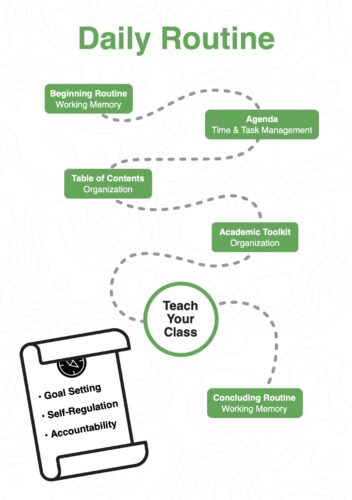
One of the key steps in that routine is modeling and practicing organization every single day. Anything a student creates or receives goes in the table of contents. I model that with my own binder—digitally or under a document camera. I introduce the lesson while students record the entry. We keep the log updated throughout the unit.
What I started noticing—aside from the fact that fewer assignments were getting lost—was a shift in how students felt. That sense of overwhelm was replaced with calm. They’d tell me, “I actually feel better.” And that made a huge difference.
But what’s interesting is that it wasn’t the students who first validated the system—it was my colleagues. Other teachers started hearing students talk about it, and they showed up at my door asking if they could use it. The ninth-grade team ended up adopting it schoolwide.
Now I work with schools across the country, and I’ve even had former students reach out as teachers, wanting to implement the system in their own classrooms. That’s been incredibly rewarding.
Wow.
Right? And I visited a school where students had ten different classes a day plus lunch. I thought it was a typo on the bell schedule. That’s a sprint. And while I feel for the teachers trying to manage that schedule, think about the students—especially those making the jump from a self-contained classroom in elementary to this whirlwind in middle school. That’s a major transition, and it’s no wonder students struggle.
If we can create unified routines across classrooms—expectations for how to start, how to prepare, where to put things—we reduce that mental load. And students start building executive functioning skills through repetition.
A lot of students with organizational difficulties feel overwhelmed by the sheer number of tasks. What strategies from your system help them break down larger tasks into more manageable steps?
Two main tools: the agenda and the table of contents. The agenda helps with time management. Every day, we preview what we’re doing, what’s coming, and how it all fits together. That predictability reduces stress. We revisit the agenda every single day, and over time, students begin to internalize that sequencing.
We also map out bigger chunks of time—projects, units, deadlines—so students start seeing the path forward. It’s similar to what project-based learning does: laying out the plan clearly and revisiting it often. Even outside of PBL, just saying, “Here’s what we’re doing today, and here’s where we’re headed” helps a lot.
The table of contents supports organization. If a student has a strong work ethic but everything is shoved in a backpack, they’re still going to struggle. But if they can organize their materials, they’re more likely to succeed.
Ideally, families get involved too. We send home a bilingual family guide with the student binder. Parents love it. It helps with conversations like: “What did you do today? What’s due tomorrow? What’s coming up next week?” And it keeps things clear, without adding complexity.
So break down the notebook system for people who’ve never seen it before. It’s a daily routine that aligns with the binder, right?
Yes, exactly. The binder is the tool for participating in the routine. And as students follow that routine, they’re practicing executive functioning skills.
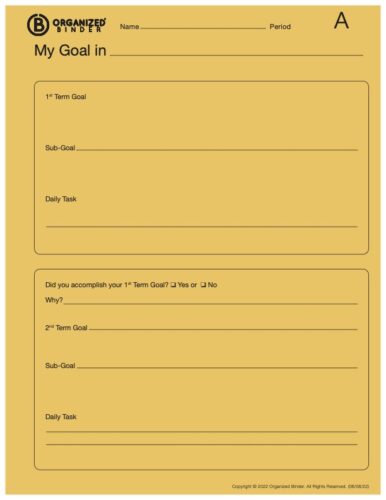
It’s a physical binder with color-coded tabs A through H. Each tab corresponds with a step in the routine. For example, Tab A is gold and used for goal setting. Students set goals every six to eight weeks, with a daily action step. We revisit them consistently.
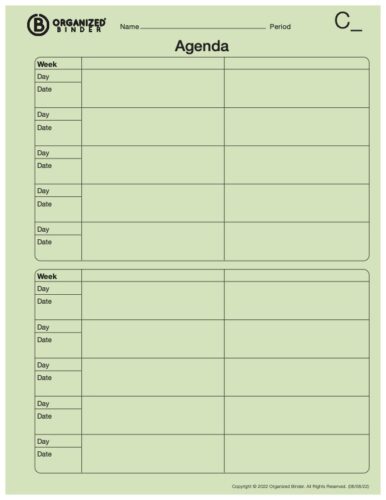
Tab C is green and looks like a calendar. That’s where we log the daily agenda. It’s where students can see what we’re doing today, what’s coming up, and what’s due.
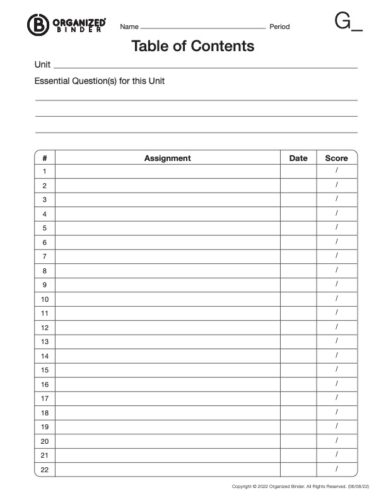
The table of contents is the third step in the routine. Every day, students list any handouts or work they’ve done and file them in the correct spot. This helps them keep track of materials and reduces overwhelm.
There’s also a toolkit section—this is where we store reference materials that students might use throughout the year. It’s like a real toolkit. If you use a screwdriver, you put it back when you’re done. Same concept here. Anything reusable goes there.
So anything throughout the course that I’m going to add as a teacher—or anything I want students to be able to reference throughout the year—goes in the toolkit instead of the table of contents. It helps students differentiate between what they’re currently learning and what they can go back to later.
And again, learning to get and stay organized is a really important distinction. Often, students see it all as just “stuff from school.” But if they can understand: this is the material I’m working on, and this is a tool I can come back to when I’m stuck—that’s powerful.
I always enjoyed moments like this time of year when I’d say, “Turn to your toolkit, number one. Look at those notes from August.” They’d all flip to it, and I’d stop the class and say, “I’m excited about what we’re learning now—but do you realize what just happened? Those are your notes from four or five months ago. You knew exactly where to find them. That’s huge. Don’t forget you can do that.”
The importance of explicitly teaching structures and strategies for staying organized
That’s a great example of being explicit with students about what we’re doing and why. It’s not just something we do for the sake of it—this is a reference tool they can go back to. I think that’s so important. Elementary teachers often have systems for organization, but by the time students get to middle or high school, there’s this assumption they should already know how.
And that is absolutely not the case. There is nothing about a 12, 13, or 14-year-old that makes them inherently organized—unless they’re naturally wired that way, or they have a very structured home, or parents who modeled it.
Maybe they’ve had a teacher who taught them, but most kids don’t figure this out on their own.
I’m especially thinking about how girls are outperforming boys in school right now. This is a big part of it—girls tend to be better at playing the game of school, being organized, developing executive functioning. A lot of times, organization is coded as “feminine” in our culture—like women are expected to be fastidious, and boys are allowed to be messy. “Boys will be boys,” right?
But you have to have these skills to succeed in school, in life, in your career.
And we have to give kids this structure. We can’t expect them to figure it out on their own—not even in high school.
Right. You’re preaching to the choir. I’ve asked thousands of teachers, school leaders, and parents about executive function, and I’ve never met one who thinks it’s a bad idea for kids to develop these skills.
Right.
But historically, we’ve left it up to chance. We just kind of hope they figure it out. I’ve tested this in rooms full of educators—sometimes hundreds of people. I’ll ask, “Raise your hand if, when you were younger, a caring adult sat down with you, gave you a calendar, showed you how to use it, held you accountable, and helped you develop the skill.”
There might be one or two hands. And usually, they’re women. I pause and ask, “Why aren’t we explicitly teaching these skills?”
There are certain things we only learn by doing them. That’s executive function. That’s why we have a daily routine. It’s repetition. That’s how students build habits. And we can’t expect mastery without practice.
Why are we doing this? If everybody here agrees that this is a good idea for students, why aren’t we embedding it? I’ve thought a lot about that. I’ll just mention this real quick—first, there’s the time crunch. Where am I going to fit it in?
Second, there’s something called the zone of genius. It’s not my term, but I love it. My mom taught second grade her whole career, and I taught ninth grade. When I’d visit her classroom, you could feel it—this was her zone. She was amazing with those kids. But me? I could last maybe five minutes. Sweaty, smiley second graders would come up to hug me, and I’d think, “Oh my gosh, I’m dying!” Give me a fifteen-year-old with attitude—that’s my zone. I feel at home in that space.
But when it comes to teaching executive functioning skills—remember, they’re not “taught” in the traditional sense—if it’s not your zone, you know it. Many teachers want to help students build these skills, but they don’t know how. And they’re also dealing with that same time crunch.
I can’t tell you how many veteran teachers have come up to me after a talk and said, “This is everything I’ve always known I need to be doing. I just haven’t gotten around to it. I do parts of it.”
And the beauty of this system is that it’s embedded into the routine. I can implement a routine and keep a class model. That alone can make a huge difference. And for school leaders listening, here’s something important: teachers can struggle with executive dysfunction, too. That class sample can be a lifeline.
Yes, yes, absolutely. Because most of us are not taught these skills, even in teaching college.
Right.
I had a classroom management course, but it focused mostly on behavior. Nothing about how to organize a classroom. How to manage materials.
As an elementary teacher, I had a lot of stuff. How do I manage papers? Email? That’s actually one of the reasons I created the 40 Hour Teacher Workweek. Teachers are expected to be productive and organized without ever being shown how.
And then we wonder why students aren’t able to do it. If we’re drowning in papers, how can we expect them to stay organized?
And we shouldn’t assume that a “good” teacher has this mastered. So many teachers are amazing with kids but struggle with organization. Sometimes it’s executive dysfunction. Sometimes they’ve just never had a system that worked. That’s what I like about your method—it’s simple. It doesn’t take a ton of time.
Right. We’re not being precious about the binder. We’re not making it decorative or time-consuming. It’s functional. And it actually helps the class routine flow better.
It gives structure to the beginning and end of class, which frames everything in between. And it doesn’t take much time at all.
That’s the key, because we don’t have enough time as it is.
So this really supports what teachers are already doing. We’ve all sat through PD that, even if it’s great, requires you to rework everything. And if you’re already overwhelmed, it ends up on the shelf.
What I love about this is we can work with a district or school, and it’s just micro-adjustments. You’re probably already doing some of it. Now we’re just doing it together. It’s realistic.
Two quick logistical questions. First, how do you incorporate digital assignments into this system?
Very easily. It’s even easier to show, but I’ll explain it the best I can. Think of your LMS—Google Classroom, for example—as the digital version of the book bag. Just having a Chromebook doesn’t mean you’re organized.
With paper, I can see the mess. Digitally, not so much. But it works the same way. Each unit has a table of contents. That same naming system shows up in Google Drive or Classroom as folders. If we’re in Unit 9, there’s a Unit 9 folder. The table of contents might list 20 items. Four or five might be digital—those are in that folder. Every assignment has a number. Students write that number on the paper version, and anything that’s digital gets highlighted in a certain color, like orange.
That tells students: this is still part of your portfolio, it’s just stored digitally. It’s not two separate things. It’s one system.
I love seeing this in classrooms—students with binders open, Chromebooks open, toggling between the two seamlessly. The analog system actually helps inform their digital organization.
I’m not anti-digital at all. But there’s power in that tactile, “knowing is in the doing” experience.
My other question is, how do you respond when a student either does not bring their notebook to class that day, they forgot, or if they have lost it altogether?
Of course, there are going to be days when kids forget stuff. That’s just part of life—we all do that. For those one-off situations, I’ll just speak from my own experience, and I say the same thing in teacher trainings.
Okay, here’s a piece of paper. Let’s write what we call the kickoff, which is how we start, and then at the end, we reflect on what we’ve learned throughout the lesson. You’re going to write it there and do the same thing as usual. You’re still participating in the routine. Then when you get home or bring your binder back, we’ll quickly update it and put it in so your portfolio stays complete.
If it’s a recurring issue—if certain kids or classes are showing a trend—then I recommend keeping the portfolios in the classroom. That way, they can’t be lost or forgotten.
I tended to do that. Space can be a challenge depending on the classroom setup, but most of the time—whether in elementary or high school—it’s not a big lift. Usually, one little bookshelf will do. Each period houses their binders there, and we use a separate folder—what we call the homework folder—that travels to and from school. So if something gets lost, it’s just that one or two things they took home to complete.
And I like that model because at the end of every class or school day, we take just a few seconds to say, “Okay, back to that agenda or calendar we talked about earlier—what do you need to be successful tonight?” You don’t need your whole binder. Do you need notes? A reference? Great—grab that, put it in your folder, and bring it back tomorrow.
Ideally, we keep binders in the classroom—at least at first for some classes—and others can take them home once they’ve shown they can manage it.
I like that. I like the idea of just bringing the folder back and forth, thinking about what you need that night, and bringing it back.
Yeah, communication to and from home is really simple that way. Very simple.
How to get started with this routine
What’s a simple starting point that teachers can implement right away to see improvement in their students’ executive function and ability to stay organized?
I get that question a lot—where do I start? Honestly, you can start anywhere with this routine. My book is written for people at schools that don’t use Organized Binder and don’t have those materials.
That’s who I wrote it for. What are the strategies? How could you do this? My encouragement is always: let’s get organized first. Once I get organized, then some of the other things aren’t necessarily easier, but they become more realistic.
And it can be very simple. Just one step of your daily routine—every time you start class, look at the table of contents: “Here’s where we are. Okay, we’re going to add these two things today.” That helps introduce the lesson and builds that predictability we’ve been talking about.
That would be my suggestion—start with a table of contents. Contact me if you need an example. There are pictures in the book, too. But that’s where I’d begin.
I want to close out with the Takeaway Truth. What is something that you wish every teacher understood about executive function and organization for students?
I don’t want to presume that people don’t already know this, but my sincere hope—especially after the pandemic—is that there’s been a shift. If there’s any silver lining from that experience, it’s that I’ve seen a real increase in interest and understanding around these skills and habits. Before, I sometimes felt like I was on an island saying, “We have to teach these skills.”
There’s been a global shift because it was a global experience. But even with that, my hope—my truth—is that someday we’ll be as committed to developing studentness in our students as we are to teaching the content. The time and finances we pour into assessments and technology—I hope we start investing just as much, if not more, into developing the learner. The whole child.
That doesn’t mean the other things aren’t important. But I want this to be seen as equally important—if not more. That’s my one call to action or truth for your listeners.
The Truth for Teachers Podcast
Our bi-weekly podcast has received over 1,200 five star ratings + 9 million downloads. You can support our work by subscribing in your favorite podcast app for free!
Explore all podcast episodes


Angela Watson
Founder and Writer
Sign up to get new Truth for Teachers articles in your inbox
OR

Join our
community
of educators
Share ideas or get advice via our social channels.


