


Education Trends, Equity Resources, Podcast Articles | Apr 6, 2025
A school design where learning feels different—and it works

By Angela Watson
Founder and Writer
A school design where learning feels different—and it works
By Angela Watson
What if school was designed around student agency, real-world learning, and deep relationships—instead of compliance and test scores?
Part of my mission with this podcast is to highlight what’s actually working in schools—to find educators doing great work and shine a light on them. I want to offer a counterpoint to the negative narratives about public education and showcase models that you can learn from and apply in your own school.
My friend Michelle Cummings from the Brisk Teaching AI tool told me I should check out the Big Picture Learning framework because there’s a lot of overlap between their mission and the work I do. When I looked into Big Picture Learning, I saw that they were offering a two-day immersive school visit for educators at a school near me in New York City. I reached out to BPL’s director of national partnerships, Sonn Sam, and he set me up.
In this episode, I’m sharing what I saw during my two days at Fannie Lou Hamer Freedom High School in the South Bronx. I observed classes, talked with students and teachers, and experienced the BPL model firsthand alongside other educators. I’ll tell you about this particular school, provide an overview of BPL, and share key takeaways and resources that I think will be useful in your teaching.
The structure of this episode is a little different from most Truth for Teachers episodes, so I want to be clear about my goals. I believe in the need for visionary leadership in our schools—educators who can reimagine what’s possible and work toward something better. My goal is to give you enough details about Fannie Lou and the BPL model to help you envision what’s possible, so you can feel inspired that change can happen, even within the constraints of the system. I also hope to spark your own out-of-the-box thinking about what’s possible in your school.
The second purpose of this episode is to provide practical strategies for moving toward a more student-centered model of learning.
So, let’s start with a big-picture view, and then we’ll dig into the logistics.
Listen to episode 322 below,
or subscribe in your podcast app
A framework for student-centered learning
Big Picture Learning is a nonprofit organization that is all about putting students at the center of their education: activating students’ potential by giving them real agency over their education.
There are 160 BPL schools across 37 states, and each one has its own unique approach and culture. BPL is not a step-by-step formula, it’s a model that can be applied by any school that wants to do so, anywhere in the country, even within public school systems. There’s no set curriculum or “rules” to follow in order to be a BPL school.
There are, however, 10 distinguishers that set apart BPL schools from traditional ways of teaching and learning, and there’s a framework that BPL provides. The shared mission of all BPL schools is to activate the potential of schools, systems, and education by focusing on one student at a time.
At its core, Big Picture Learning isn’t just about rethinking school–it’s about building a system where, in the words of Elliot Washor, “students are the curriculum and the community is the school.”
To make this vision a reality, Big Picture Learning uses a framework called OARIA—a way to ensure that everything happening in the school is rooted in deep, personalized learning experiences:
O – One Student at a Time System
Every young person has unique brilliance, and the education system should cultivate that. Instead of one-size-fits-all instruction, students at BPL schools have Individual Learning Plans that help them explore their interests and take ownership of their learning.
A – Advisory System
Relationships are at the heart of learning. BPL schools structure their communities around advisories—small groups where students connect with a dedicated advisor for at least two years. These advisories create a foundation of relationships, relevance, and rigor, ensuring every student feels known, supported, and challenged.
R – Real-World Learning System
Learning shouldn’t be confined to the classroom. Students actively pursue their passions in the real world, engaging in internships and mentorships with professionals who help them apply their learning in meaningful ways. These authentic experiences prepare students for college, careers, and life beyond school.
I – Interest-Driven Project-Based Learning
When students are co-designing their learning, they stay engaged, curious, and motivated. Instead of being assigned generic projects, they work on interest-driven, hands-on projects that align with what they care about. Whether it’s a passion project or an independent study, the goal is to make learning deeply personal and student-led.
- Passion Project Template/Independent Project Planning Guide/Sample Project Explosion Template
- Personalization (One Student at a Time) & Interest-Driven PBL
A – Authentic Assessments
Learning isn’t about memorizing facts for a test—it’s about demonstrating what you know in real and meaningful ways. BPL students showcase their learning through exhibitions, portfolios, presentations, and teaching others. These assessments are public, reflective, and tied to real-world skills, making them far more powerful than a traditional test score.
BPL offers school choice within the public system
So the OARIA framework is what all PBL schools have in common. Let me tell you what this looks like at Fannie Lou Hamer Freedom High School.
This is a school within what the principal shared is the poorest Congressional district in the country. It is a public school within the NYCDOE, which is a massive system that can have a daunting amount of bureaucracy to navigate.
This is a really important fact because often, innovative teaching and learning happen in more affluent schools and in charters or private schools that work without the constraints of the public school system. The fact that the non-traditional BPL design is thriving within the NYCDOE is really exciting to me.
So, Fannie Lou is a public school choice that any local student can opt into. Unlike lottery-based schools, students don’t have to apply or compete for a spot. They just have to select it instead of the larger, more traditional high school in the community.
For some students, this choice is life-changing. One student shared that they chose Fannie Lou because their old school didn’t feel safe. Here, they shared, “I feel like part of a community. I have access to a social worker. I have relationships with teachers and staff in a way I never had before.”
Another student said, “Before, I didn’t find it important to have relationships with staff or friends. Now, I know my principal. That wasn’t even possible in my previous school.”
Teachers also choose to be here. They have to believe in the design and be committed to student-driven learning. Families, too, must be all-in—they agree to attend exhibitions, engage in their child’s learning and understand that this school operates differently than a traditional one.
All parents, kids, and teachers are taught the markers of high-quality learning so that they’re not looking to test scores or weekly quizzes to assess student learning.
This buy-in is critical because students at Fannie Lou opted out of standardized testing. Yes, you heard that correctly—they use a portfolio-based assessment method that I’ll share more about later on.
I’ll also mention that the local elementary and middle schools in the area do not follow the BPL design and were described to me by folks at Fannie Lou as traditional and compliance-based in their approach to learning. Students arrive at Fannie Lou accustomed to compliance-based learning, where their primary role is to follow instructions rather than engage in deep inquiry. At Fannie Lou, they are asked to think critically, write extensively, and revise their work until it meets high standards.
I share that not to criticize the folks doing the work in those other schools but to show that students can be successful in non-traditional learning design at the high school level, even if they had never been exposed to it before and had a very different K-8 schooling experience. It’s an adjustment for sure, according to the students I talked to, but it’s clearly never too late to introduce a student-centered way of learning to kids. Many students come from middle schools that did not encourage independent thinking.
Place-based learning and connections to the community
I mentioned that BPL does not mandate specific practices but provides a framework that allows schools to shape their own identity. Fannie Lou has definitely adopted a place-based approach to learning that is unique to the Bronx and the surrounding community.
The school serves a diverse student body, with 29% identified as special education, 16% as English learners, and 94% coming from low-income households. Fannie Lou’s educators make it clear: We are here to serve everyone in the community.
Fannie Lou is viewed as more than just a school—it’s a community hub. The nonprofit Children’s Aid has an office inside the school, providing wraparound services so that teachers can focus on teaching. They help with everything from social services to food support.
One staff member shared, “We think differently about parent involvement. Our school treats kids like young adults rather than micromanaging their behavior. We don’t call parents for every little thing. We help in small ways that you don’t always notice. If we have extra food in the pantry, we make sure families take it home. Around the holidays, we send food home, too. We’re not just calling home if a kid is doing good or bad—we’re making sure they’re okay.”
Fannie Lou is structured around the belief that students learn best when they engage deeply with meaningful work—work that challenges their intellect, sparks their passions, and connects them to their communities. The roots of this philosophy go deep, and even the name of the school is intentional. Fannie Lou Hamer Freedom High School draws inspiration from the Highlander School in Tennessee, which was known for training civil rights activists and fostering education as a tool for liberation.
It was named to honor the legacy of Fannie Lou Hamer, a civil rights activist who fought for voting rights and social justice, despite enduring brutal oppression. The school’s founder saw striking parallels between the systemic struggles faced by Black communities in the 1960s American South and the social, political, and economic challenges of the South Bronx in 1984, where the school was founded.
The addition of “Freedom” in the name was drawn from the 1964 Freedom Summer and its Freedom Schools, which aimed to educate and empower students to challenge injustice—principles that align closely with the school’s mission.
Fannie Lou Hamer Freedom High School exists not just to commemorate her legacy but to embody her vision of education as a means of self-determination and collective struggle for justice. The core idea is that people should become agents in their own learning—and in their own lives. Freedom school teachers were trained to ask students questions and challenge them to find their own solutions, rather than simply deliver information.
That same mindset is alive at Fannie Lou, where students are expected to think critically, reflect on their learning, and take an active role in shaping their education.
Class sizes and block structures to foster deeper relationships
The class sizes at Fannie Lou are remarkably small. Most classes I observed had around 10 students. The principal shared that this is partially by design (he’s allocated more funding to staff and less to other areas) and partially by circumstance, as enrollment in city schools is down. In fact, NYC public schools have lost more than 200,000 students since the start of the pandemic. And for the 2024-2025 school year, NYC schools have suspended budget cuts so that lower enrollment does not lead to teacher layoffs and larger class sizes. The city’s 2022 Class Size Reduction Act has brought the mandated max down to 25 at the high school level, and they want to keep it that way.
It’s possible that next year, schools like Fannie Lou could lose funding if enrollment doesn’t increase. Principal Jeff Paladino says, “We’re hoping to get them [the students] back.” If that doesn’t happen, he’s made it clear he’d rather cut from other areas before cutting staff, because relationships are the heart of the school.
The low teacher-to-student ratio and small school size (around 480 students) are invaluable for students who felt invisible in their previous schools, who didn’t have a strong support system, or who needed a place where learning was about more than memorization and test scores.
But the small school design does come with tradeoffs. There are things Fannie Lou simply can’t offer—no marching band, no three-language course options, fewer extracurriculars. Students who select Fannie Lou know they won’t be taking AP classes, as those aren’t part of the design. Instead, they’re choosing a school that is committed to serving students as whole people, honoring their intellect, and giving them the space to find their purpose.
In addition to smaller class sizes, the personalized attention and family atmosphere of the school are a result of the block scheduling. There is no class period at Fannie Lou shorter than 1 hour and 15 minutes, allowing students to go deep in their learning.
One student shared that in their previous school, they had eight teachers a day. Here, with longer block scheduling, they have just two to four teachers per day, making it much harder to go unnoticed or skip class. They said, “In my previous school, teachers often needed reminders of my name. I had to keep telling them who I was. Here, every adult in the building knows me.”
This student said they chose Fannie Lou because their mom specifically sought it out and wanted them to have that level of support. The student wishes there were SAT prep classes, but their advisor has been helping them with that.
A different school culture and energy within the building
The culture at Fannie Lou is unlike anything I’ve seen before. I’ve done a lot of instructional coaching in the Bronx over the years, in both public K-12 schools and Catholic schools run by the diocese. My husband was raised in the Bronx, and most of his family still lives there. So I’m familiar with the culture and the history, as well as what’s happening in the local schools.
What struck me the most about Fannie Lou was how calm and emotionally regulated everyone in the building was. New York City is not a calm place. It takes a lot of intentionality to have nearly 500 teenagers in a building and maintain calm. When I first arrived, the entire 9th and 10th-grade classes were sitting in the cafeteria, waiting for the school buses to take them to their real-world learning sites, called ELOs (Extended Learning Opportunities).
There was no yelling, either from kids or teachers. I never heard a staff member raise their voice at a student the entire two days I was there. The kids clearly feel comfortable and safe. There is a culture of respect—self-respect, respect for peers, respect for adults, respect for the building, and respect for their education. Anyone who works in schools knows how incredibly difficult this is to pull off, and how precarious any moment of calm can be. But it’s truly just the vibe at Fannie Lou, and again, unlike anything I’ve witnessed before in the entire 25 years I’ve been working in education.
There’s no one obviously in charge in any room I stepped into. You have to look hard to find the teacher in the classroom or the staff in the cafeteria. No one shouts directions. The kids aren’t making loud noises, running, or goofing off. They’re relaxed. Everyone is just sort of co-existing in a way that felt very remarkable.
We did a Zoom call in the cafeteria on our last afternoon with students at BPL school in Philadelphia, and students from Fannie Lou not only ran the panel and Zoom meeting but also participated in the cafeteria with the educators who were visiting the school. It ran for about 45 minutes. Every single student was participating appropriately, with no reminders. Phones are kept in Yondr pouches and not accessed during the school day, so no one is staring at their phone. They were not having lengthy side conversations with their friends. They asked questions of their peers in the Zoom, and the questions were on-topic and appropriate.
I’m making such a big deal of this because this level of functionality within the school wasn’t achieved with compliance, fear, threats, punishment, or crushing kids’ spirits by forcing them to do what they’re told.
This is what genuine buy-in looks like. This is how kids behave when they’re really invested in their learning when they’re invested in themselves. This is how kids act when they value and respect themselves: they extend that respect to others in the learning environment.
I observed adults willingly sharing power with kids. The kids call their teachers by their first names. And they know each other.
The school has metal detectors at the entrance with NYC school safety agents conducting checks. But even the safety agents know the kids and greet them by name. A process that could feel dehumanizing is humanized by the relationships they have. It’s not a police officer making sure you’re not going to bring harm to the school—it’s a police officer keeping you safe, looking out for you, checking in with you and your peers.
Advisory periods are the heart of the school
So what exactly is happening in the learning environment that is creating this kind of culture?
The advisory period was described by both staff and students as the heart of the school.
In Big Picture Learning schools, advisory is not an extended homeroom, and it’s definitely not a glorified study hall. It’s the opposite of that. Advisory is about relationships, relevance, and rigor—a structured, intentional space where students and advisors build deep connections that support both academic and personal growth.
At Fannie Lou Hamer Freedom High School, students stay with their advisory group for two years, with mixed-grade advisories for 9th and 10th graders and a new set for 11th and 12th graders. They also switch advisors when they move into the upper division, but the sense of community remains.
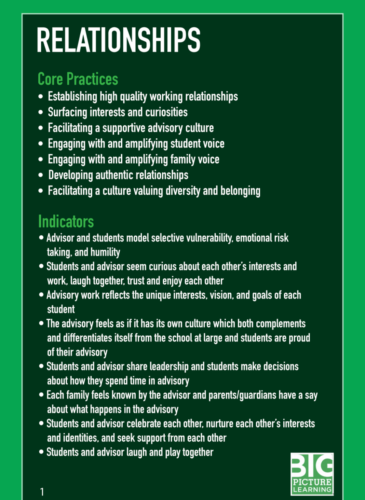
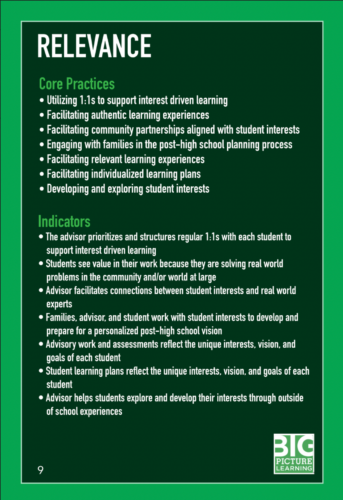
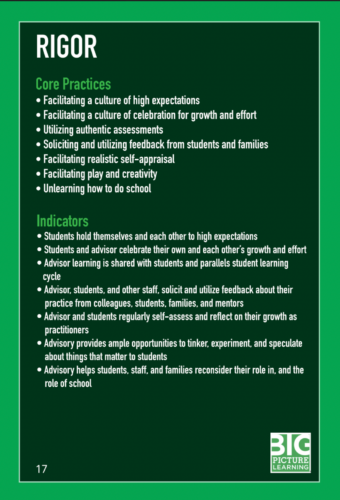
Another differentiator with advisory is the amount of time dedicated to it: one entire hour a day, four days a week. Each week, advisory follows a four-day structure:
- One day is for academic assistance—a chance to catch up on work and get support.
- One day is for life beyond Fannie Lou, discussing college, careers, and future plans.
- One day is focused on restorative justice and social-emotional learning, helping students develop conflict-resolution skills and emotional intelligence.
- One day is purely about community-building, playing games, having fun, and deepening relationships.
Advisory is the backbone of student support. Each advisor is responsible for parent communication—texting parents, keeping them informed, and addressing concerns before they become bigger issues. This means that teachers share the workload of student outreach, rather than placing all the burden on subject-area teachers. If a student is struggling, the advisory period gives the advisor a built-in hour each day to check in, problem-solve, and reach out to families as needed.
For students, advisory is more than just a class—it’s a family. One student described it like this: “My advisor is like my school mom, and the other kids in my advisory are like my siblings. If we have problems, we have to work it out because we’re like family.” The relationships formed in advisory extend beyond the classroom. “If I see someone getting picked on in the hall, I stand up for them,” another student shared. “Because I’m going to have to look them in the eye at advisory.”
This kind of deep, ongoing connection is what makes advisory different at Fannie Lou—it’s not an afterthought.
High-quality advisory period observation tool
How teaching and learning are different in a Big Picture Learning school
So the major differences in the way Fannie Lou is structured vs. a more traditional school are the lengthy advisory period with continuity over the years so it feels like a family, and kids and the advisor get to know each other deeply. It’s the longer block schedule, where classes are at least an hour and 15 minutes long. It’s the looping with teachers over 9th and 10th grades, and again in 11th/12th. It’s the smaller school size and class size.
Let’s talk now about the difference with academics, and how teaching and learning are different within this BPL school.
At the heart of Fannie Lou’s design is an emphasis on habits of mind: viewpoint, evidence, connections, relevance, and conjecture. In practice, this often sounds like:
What do I think?
Why do I think this?
Why does it matter?
These questions guide students in every aspect of their learning. The group of us who were participating in the school visit saw this over and over again when we interacted with students. They had ingrained the habit of identifying what they think, examining why they think that, and why it matters. The kids were highly opinionated and quick to justify their opinions. They used language like, “I think this and I can defend that belief because of this.”
That’s in large part because writing and revision are central to the school’s approach. With no standardized tests and a portfolio-based approach to assessment, kids are accustomed to having to defend their learning. All students are required to reflect on each project to develop metacognition—the ability to think about their own thinking. Instead of focusing on grades, students are ranked on a 1-4 scale, with 4 being the highest.
There are no bells signaling the start and end of classes. Instead, the day flows in structured 15-minute increments that both students and teachers understand intuitively. The result is an environment where learning feels more natural and less dictated by external constraints.
Fannie Lou’s curriculum is highly interdisciplinary. In grades 9 and 10, students take integrated math/science courses and ELA/humanities courses, with frequent opportunities to work across all four subjects. One standout example is a project on the Bronx River and environmental racism, which helps students explore how the Cross Bronx Expressway divided communities and contributed to environmental and social injustices.
This kind of Extended Learning Opportunity (ELO) goes beyond the classroom. Students engage with real-world institutions, such as JP Morgan or Madison Square Garden, to see how their learning connects to broader societal systems.
Fannie Lou actively integrates community-based learning into its weekly schedule. On Tuesdays and Thursdays, half of the 9th and 10th graders leave the school to engage in service learning, rotating between working in local schools, community centers, environmental projects, and even recreational activities like tennis.
Those of us participating in the school visit got to experience this, and true to the Big Picture Learning design, we weren’t told where to go and what to do. We had three choices. I selected the Bronx River Arts Center, where kids were exploring storytelling through 2D art. I also got to visit the Bronx River Environmental Center directly across from the school, where students test the water quality and can speak extensively on whether the Bronx River is healthy. (Spoiler: it is! The plant and animal habitats are now thriving there, thanks in large part to community activists, organizers, the work of young people, and partnerships with local schools.)
Here’s the really cool part for those of us who are obsessed with protecting teachers’ planning time: half the 9th and 10th graders leave the building for three hours on Tuesday mornings, and the other half on Thursday mornings. The Spanish and art teachers, along with paraprofessionals, accompany the students who leave the building. The remaining 9th and 10th-grade teachers have an uninterrupted three hours of planning time in the building while their students are away. So maybe Tuesday morning you have that planning time, and Thursday morning you teach the 9th and 10th graders who aren’t leaving the building. It’s really a win for everyone.
So 9th and 10th graders do these ELOs. For 11th and 12th graders, internships take place in the middle of the school day, providing hands-on experiences that align with their interests. While the school is unable to offer a full-year internship for every student due to its size (480 students), the commitment to real-world learning remains central. Every student who wants to work during the summer is guaranteed a job—100% summer employment.
Balancing competency-based learning with high stakes accountability
What’s most exciting to me is that all of this is happening within existing systemic constraints. Like all 160 Big Picture Learning schools across 37 states, Fannie Lou exists within a compliance-driven system. All of these schools are graded on performance, including standardized test scores. Even though Fannie Lou has been exempt from certain state tests, the school still has to navigate the reality of proving success in a way that satisfies the system.
As Sonn Sam, Director of National Partnerships for BPL, put it: “Our schools have to do two dances. Everything starts and ends with students, but we also exist in a compliance-driven system that will shut us down if we don’t perform. So we have to do salsa, waltz, everything… and get good at lots of different dances.”
This means balancing interest-based, student-driven learning with traditional accountability measures.
Sonn suggested approaching this through the lens of a guiding question: How do you find high-quality learning in your community? What does it look and sound like?
He says, “If you don’t have a clear definition, and staff and students don’t have a shared understanding of what high-quality learning looks like, you have to start there,” he explained. “Otherwise, they’ll just say they want 37 AP classes. But high-quality learning is about young people’s agency—diving into things they’re interested in. That’s what we have to figure out. Who are we as a school, and what do we value about high-quality learning?”
This is the rationale for Project-Based Learning (PBL): it isn’t just about completing assignments—it’s about engaging with meaningful work. PBL can take different forms:
- Student-driven – Projects based on individual interests and passions.
- Real-world problem-solving – Tackling authentic challenges in the community.
- Connected to existing good work – Building on initiatives already making an impact.
The most powerful projects integrate academic skills, industry skills, and social-emotional skills—what some call the trifecta of deep learning. Students are developing literacy and numeracy while also gaining real-world competencies and the ability to collaborate, reflect, and persist through challenges.
So students are learning academic skills through projects and place-based learning, but they’re also beginning to use AI in bridging the gap between student-centered approaches and the high-stakes assessment approaches of the larger school system.
Playlab is one such tool. It helps students develop skills in a way that aligns with competency-based learning, making test prep feel more meaningful and personalized rather than disconnected from their interests.
One BPL school in Nashville has taken this even further—their entire senior class is competency-based, using Playlab to assess and support student learning.
By leveraging AI, BPL schools are continuing to refine the balance between agency and accountability—ensuring that students are both prepared for the system they exist in and empowered to challenge and transform it.
Case studies of student learning
Student-centered learning doesn’t require anything fancy or expensive
A final piece I didn’t mention about Fannie Lou is the physical building itself. It’s clean and well-maintained, but there’s absolutely nothing exceptional or flashy about it. In its former life, it was a factory that was later converted into a school. There is no PTA raising half a million dollars for a new science lab.
It’s an old building with lots of old equipment. Green chalkboards and white chalk are still in use within every classroom (though an LCD projector and pull-down screen are also used). The walls feature student work but no cutesy bulletin board sets or expensive decor. There are books and notebooks on the shelves, and student art on the windowsills, but no immaculate matching organizational systems.
In short, the resources and circumstances that Fannie Lou operates with are in line with what’s typically available to other schools. The magic of Fannie Lou—and what they’re doing with the Big Picture Learning design—isn’t in the stuff or external trappings; it’s in the people.
It’s a model of what it looks like to actually make relationships the center of a school instead of paying lip service while spending the vast majority of time and resources on traditional ways of doing school. There is nothing fancy, no magic bullet, no “one trick that will transform your school” about this approach.
The BPL approach is about slow, steady change over time, about honoring students’ intellect and truly empowering young people through a highly deliberate and intentional way of centering their interests and lives. And it’s energizing for me to see, because there is a hopefulness in that: something better is possible for our schools, our educators, our young people.
I hope that the resources in this article have helped you envision what else might be possible in your school. It’s not going to be easy, but it’s going to be worth it.
Additional Big Picture Learning resources
- 10 Expectations students have of us and their schools
- 10 Distinguishers between the BPL framework and traditional learning
- O-A-R-I-A: The 5 Core Student-Centered Learning Practices
- Innovation page to learn more about BPL initiatives
The Truth for Teachers Podcast
Our bi-weekly podcast has received over 1,200 five star ratings + 9 million downloads. You can support our work by subscribing in your favorite podcast app for free!
Explore all podcast episodes


Angela Watson
Founder and Writer
Sign up to get new Truth for Teachers articles in your inbox
Discussion
Leave a Reply

OR

Join our
community
of educators
Share ideas or get advice via our social channels.


Hi Angela!
Thank you for this wonderful podcast and post about Fannie Lou! Wanted to ask about a few things I got curious about:
1. Did you get a chance to see how teachers plan their lessons?
2. Were you able to observe any specifc lesson structure for the 75-minute duration?
3. How is their PD regarding lesson observations?
Big hug from Brazil!
Hey Dani,
I know Angela can answer your questions, but I am offering myself as additional support if you are interested. My name is Sonn, and I am the National Director of Partnerships with Big Picture Learning. You can email me [email protected]
Be well!
Sonn