


Education Trends, Mindset & Motivation, Podcast Articles | Feb 1, 2026
Everything all at once: what it’s like to be a teacher with ADHD

By Angela Watson
Founder and Writer
Everything all at once: what it’s like to be a teacher with ADHD
By Angela Watson
When Andrew Gardner got his ADHD diagnosis at 30, his first thought was, “Okay, now what? I’m still an idiot.” That negative voice had been with him his entire teaching career, driving him to work 80-90 hour weeks trying to prove he wasn’t failing at the basics everyone else seemed to handle easily.
In this conversation, Andrew walks us through what it’s actually like to teach with ADHD. He shares the invisible struggles no one could see from the outside, the white-knuckling through administrative tasks, the depression that came from years of that critical inner voice telling him he couldn’t do basic things that weren’t actually that hard … and eventually, the reframing that changed everything.
Andrew now has over 25 years experience innovating in teaching, learning, facilitation, technology and management. He’s taught students from preschool through post-graduate at Yale, Columbia, NYU, and Harvard, advising on and evangelizing the use of technology to help students and teachers become future-ready. He spent over a decade building and leading a professional learning department, certification program, and teacher community at BrainPOP (where he and I were coworkers!)
Since then, Andrew has combined his passion for organizational alignment with his foundation in constructivist teaching and learning into coaching leaders, professionals, and parents. As an ADHD coach, Andrew is especially attentive to supporting the needs and strengths of neurodiverse clientele.
Andrew shares how ADHD shows up differently in the classroom (spoiler: “attending to everything all at once” has some serious superpowers), the link between undiagnosed ADHD and depression in adults, and what it takes to start seeing neurodivergence as a strength rather than something to overcome.
Andrew also shares practical insights on what schools could do differently, how to help students with ADHD build metacognitive awareness, and why getting on the balcony to observe your own thoughts might be the most important skill for managing ADHD as an adult.
Listen to episode 341 below,
or subscribe in your podcast app
Sponsored by Mia and Tiago Books
ANGELA: So, Andrew, you were diagnosed with ADHD in your thirties after years of not understanding what was going on in your brain. Can you walk us through what that moment of diagnosis felt like and what finally made you seek an evaluation?
ANDREW: It’s a curious moment. I actually went back and looked at my evaluation again when I knew we were discussing this. It was dated 2007, which was when I was thirty. And I remember in some way saying, “Okay, now what? Because I’m still an idiot.”
I had all this self-talk in my ear that was saying, “You just don’t know how to do anything. You’re an idiot and you don’t know how to work and it’s so hard for you to follow through on things.” So what difference does a diagnosis make?
But then when I looked through the details of the actual evaluation, it showed high performing in this area, high performing in this area, high performing in this area. Then the executive functioning stuff was just super low. And I was like, “Oh, okay. So there’s this one real area that I struggle with.”
There were also suggestions of potentially a mild language learning disability, which teachers had mentioned historically, but nothing was ever formally done about that. So at first it was like, “All right, whatever,” because that loud voice of negativity was still very present. But then when I looked at the data it was like, “Okay, I’m not a global idiot. I struggle in some areas.”
What brought me to getting the diagnosis was that throughout elementary school, high school, and college, I always did fine, but I never did great. As I got older and the academic expectations got more challenging, I got into this habit of finding the path of least resistance. I didn’t challenge myself much in high school or college. I kind of just got through.
In college, I was an American studies major in the late nineties. That meant everything in the entire course catalog cross-listed, so I could take whatever I wanted. I focused a lot on music and improvisational music. I was a musician, and that’s where I did better. I was actually pretty good at listening to other people and playing along and being in the moment and figuring things out. I was never very good at reading music.
All of that made me realize that in some areas I’m pretty good, and in some areas, especially when it comes to hard work, I’m usually pretty avoidant.
I went into teaching in some ways because I was like, “I don’t have any skills to do anything, but I can hang out with three-year-olds.” I started teaching preschool right after college. I always liked children. I always liked the interpersonal piece.
So I went into working with preschool students and recognized, “Oh yeah, running a classroom, sure I can do that.” I still had a lot to learn, of course. I come from a family of educators, so I ended up going to graduate school for education and I was pretty good at it. I had some decent instincts.
I taught for five years before the diagnosis, all with pre-K, then first, then second. Actually, the year I got diagnosed, I switched from being a classroom homeroom teacher to being a tech integrator.
I think the ADHD diagnosis was a validation that even when I was teaching and brand new, I was much more interested in innovating or doing things differently. I could teach reading, I took reading methodology courses and understood how to do that. I could do writing. But where I was in this school in 2003 that had a big emphasis on technology, twenty-four first graders and twelve MacBook computers, it was like, “Okay, try it out, see what you can do, Andrew.”
So I was using a lot of assistive technology, even though I wasn’t calling it that. The ADHD diagnosis was a validation that I kind of think outside the box. I do things differently. I like the novelty, and following the directions or following the norms doesn’t always work that well for me. I have this kind of anti-authority thing that’s a bit ADHD and probably a bit of my own psyche or temperament.
But it was a validation that a lot of people with ADHD are in the innovative, entrepreneurial space because, as Ned Hallowell, who’s one of the big authorities on ADHD, talks about, the impulsivity of ADHD, if you think about it differently, that’s also the creativity. You’re jumping into trying something new without stopping yourself.
And the distractibility is kind of the curiosity. You have trouble regulating your attention, so you’re attending to everything all at once because you’re curious about it all. Or then you get into this hyperfocus where you can just dial into something super deep because you can’t find that middle ground. It’s like you’re hyperfocused or you’re attending to everything.
Which, attending to everything is kind of a great superpower as a teacher because you do have those eyes on the back of your head and you’re seeing everything going on all at once. That helps you stay at that level of stimulation that you need to be present. And the hyperfocus is powerful too. I could video edit forever in college because the speed of putting together things and trying to tell a story was so stimulating. I could do it for literally hours and be like, “Whoa, where’d the time go?”
Same with music. I would improvise with people and play for hours because you just get into that zone and it feels so alive. You’re in the moment and time and space kind of drift away because you’re just in it.
So there are secret superpowers for teaching if you can access that stuff in a setting where you’re set up for that. It just wasn’t really aligned with my own strengths, which I attribute a bit to ADHD. I’m framing this now as, “Hey, some of my strengths are due to ADHD,” rather than this idiot voice that I had when I was first diagnosed and for the first three years after.
I now recognize, twenty years later, that these habits of mind or ways of being or neurodiversity served me in certain ways. I just wasn’t able to name it and embrace it and internalize it. But I’m older now and able to evaluate it that way.
It took me years to realize I’m not lazy. I’m neurodivergent.
That answers my question, because you’re talking about how being ADHD shaped the kind of teacher that you were and the things you were better at because of it, and also the things that were more challenging. I’m wondering, as you look back at your time as a classroom teacher, what were the invisible struggles happening that no one around you could see? Because I know you were a good teacher. From the outside, things looked good. But what was masking or coping with your diagnosis like for you?
I think that “everything all together all at once” feeling as a teacher was the heaviest thing ever. I really struggled with breaking down the scope of my responsibilities as a teacher and recognizing that I could nurture all of these things in different ways, but maybe I could dial more deeply into one and get better at that, then dial more deeply into another.
I was constantly doing eighty-hour, ninety-hour weeks, just trying to do everything perfectly because the expectation for myself was unattainably high. The definition of frustration is the gap between the expectation and the amount of effort it takes to meet that expectation. When the effort supersedes what you think it should, you become frustrated.
I walked around in my life so frustrated and so unable to make space for anything other than teaching. It was just endless. I was in the schools on the weekends, or at home working on the weekends. Most of my twenties, when many people are getting some social growth, I was just professionally teaching-driven.
It served me in some ways. I put in a lot of energy and I got better at it. But I was also spending a lot of time listening to that critical “you’re an idiot” voice. The only way I could talk back to that voice was through just putting in time. And it wasn’t even necessarily good use of time. Angela, you’re the queen of recognizing the energy and associating that with the impact. I don’t think a lot of the energy I put in had the impact I was hoping it would have.
People always saw me as a hard worker, but I literally could not take compliments. People would be like, “You were great at the assembly,” because I played a lot of music with the kids, and I’d be like, “Oh, I screwed up that third chord.” The self-image seemed humble maybe to others, but to me it was just living in a place that felt really sad and depressed.
I was on antidepressants at various points because the ADHD, the frustrations, and my ability to motivate myself to do things other than just by white-knuckling manifested as me feeling depressed. So I was treated for depression.
In more conversations with therapists, it was like, “Well, maybe there’s something else here that’s not just depression,” because the patterns I was describing sounded a little bit like ADHD. Of course, I had the old version of ADHD in my head, which is the hyperactive kid on the rug in the eighties. My brother had actually been diagnosed with ADHD as a kid, but I hadn’t. I was more inattentive, he was more hyperactive. My diagnosis is inattentive subtype.
Even though there was some awareness of it in the family, I was fine. So the struggles were intense and internal. You may not have seen it externally. It was really just about confidence and time management. I had no ability to have any kind of balance in my life.
How (and why) schools should support neurodivergent educators
The negative self-talk, the self-image, the hypercriticalness sounds more like it was coming from depression. Is that accurate to say?
I think there’s a link, and I think this happens for a lot of people who are diagnosed as adults. They may have been feeling depressed because that negative voice pops up in response to, “Hey, this is what you’re expected to do, and you can’t do it because of some form of neurodiversity.”
That negative voice is like, “You suck. You can’t do this basic stuff. You can’t fill in a form. You can’t motivate to go and put the grades into the system.” Just administrative, boring stuff that’s not that hard to do. You literally cannot. You’re so stuck.
And there’s no explanation. Like, what the heck? It’s not hard to do. It takes a little time. And I’d prefer to put in hours doing other, more tangential, innovative, weird things than doing the basic stuff that’s needed. Beating myself up for that, and that repetitive beating up, built up that voice. That voice was built up because of a neurodivergent deficit associated with ADHD.
The idea is, if you treat the ADHD and you’re able to actually regulate the attention, you’re still attending to a lot of stuff and you’re still able to hyperfocus, but you’re also able to do some of the stuff that’s just necessary. Go to a to-do list and check things off. Whoa, I actually can do something.
The actual ability to follow through and do some of the work that was so challenging for you becomes the evidence to show that negative voice, “Actually, wait, I can get stuff done.” That negative voice is like, “Oh well, you still suck.” And you say, “Well, but look, I’m getting it done.”
This is a lot of the work that I do as an ADHD coach and in coaching in general. They call it systems work or IFS, internal family systems, where you begin labeling and naming these different voices that exist inside us and talking to them.
I think you even did an episode about this internal talk on your podcast a few months ago, with Lily Howard Scott.
How teacher language shapes us—and teaches kids to find their wisest self
Recognizing and naming those voices and actually creating personas around them. I often will be like, “Hey, what’s this voice’s name and who represents this voice and what does it look like? What’s it dressed up as?” So that you can literally start disentangling or disaggregating that voice from your own being.
Because you can also have your inner sage or your inner entrepreneur or innovator who’s doing interesting things. That negative voice may say, “Ah, it’s not that great,” but actually, maybe it is. Because the only thing I’ve ever gotten recognition for professionally is trying innovative, different things.
I was a fine reading teacher. I did okay. My students all got better. I was decent with math. But when I brought songwriting into the classroom or when I was using technology, that’s where it was like, “Oh, this guy’s doing things a little different and interesting,” helping first graders build metacognition through talking about photographs that are important to them. That’s where I started getting recognized.
I was so dependent on that external validation because my internal validation was not strong. It was just doing to do. So it was the combination of the diagnosis and getting medicated. The medication was super helpful for being able to find a bit more regulation attention-wise.
That piece you were saying about identifying these different inner voices is so powerful. I’ve been working with that a lot, being the observer of my thoughts. As a yoga practitioner, as someone who’s studied secular Buddhism, being the watcher of your thoughts. You are not your thoughts, you’re watching your thoughts. You’re not a brain, you have a brain. You’re not a body, you have a body. Stepping back.
It’s taking me years of practice to really start seeing the power of that. To be in a moment of conflict or stress, or feeling a reaction coming up in me, and being able to step back and see what’s happening. To observe what’s happening in me, what’s happening in the other person, and to name it without judgment is so powerful.
That’s a bit of what I hear you saying where you’re talking about your inner sage. Maybe it’s an inner child, a younger version of yourself that has a specific wounding being triggered. You have the critic inside of you sitting on your shoulder watching everything you do and say, saying, “This isn’t good enough. Who do you think you are? You’re so cringe. You’re such an imposter.” Being able to notice that and name that as parts of you feels really powerful. I’d love to hear you speak on that.
Yeah, I think what you’re describing, there’s a lot of work around these parts and being able to step back, name them, observe them, then come back to them. The negative voice specifically has served me in plenty of ways, but it also doesn’t serve me in some ways. Being able to name that and recognize that is a huge piece of being able to live with it, because it’s not going to go away, nor should it.
Nir Eyal, who wrote this book Undistractable, writes a lot about what we do with discomfort. The discomfort that we feel is evolutionarily advantageous. Because we’re hungry, we go and seek food. Because we’re cold, we go and seek fire and warmth. These are things that are necessary for us to survive.
Those feelings are very exaggerated now because we’re living in much more heady times. The burden for us now is that we have to lean into this discomfort, and all of the tools and devices around us are constantly helping us avoid that discomfort.
That’s why we’re looking for distractions rather than traction. We go and do a scroll, or it’s not even scrolling, it’s looking at things that help us not feel that discomfort when we’re struggling with something.
A first step is trying to get this under control a little bit, which is much easier said than done. Recognizing, “Hey, when am I reaching for my phone? When am I reaching to escape this discomfort I’m feeling?”
Typically, you feel discomfort because something is hard. Because something’s hard, you want to go and avoid it. That voice of “Oh, this is hard,” you don’t even want to hear that voice, so you just go and ignore it by finding something that takes your mind off of it. Which can serve you for a moment and may be necessary, because often if we’re trying to come up with an idea or work through a problem, the brute force approach isn’t actually effective.
I love Annie Murphy Paul’s The Extended Mind. The brute force thinking and being in your head to work through something or get through the discomfort doesn’t always work. It rarely works. We are embodied beings. The movement and stepping away from something and moving or doing something different can allow our minds to process, but not if we’re just going to distraction to get away from the pain or the discomfort. It has to be a bit more deliberate.
“I’m struggling with this problem right now. It’s not going to go anywhere, but let me go take a walk around the block and think about something else. Or let me listen to a song.” Be deliberate in something to disrupt this overwhelming discomfort I’m feeling, rather than just reactionary and distractible in my regulation.
There are some people, I took this course called PQ, Positive Intelligence, which is about using these ten-second micro meditations where you just dial into one sense for ten seconds. Put your fingers together and just feel the exquisite sense of how your fingers are incredible mechanisms for touching stuff. Do that for literally ten seconds to get you out of your discomfort head zone, ground yourself. “Whoa, this is freaking amazing.” Experience a little awe, and then that voice that’s making me feel bad about myself is like, “All right, you’re not everything, little negative voice. This moment was pretty cool because I experienced awe. What’s my better voice have to say?”
There are all sorts of disruptions you can do, but you need to be deliberate about them. More often than not, we’re just reactive and avoidant. So sitting with discomfort and recognizing what to do when it comes up, I feel like, is the center of life at this point.
Yes, that’s the work. That is the work. In your role with the ADHD Coaches Organization, you consult with lots of different types of people. I’m curious about how ADHD shows up differently across different ages, different genders, different personalities. What have you noticed?
There are certainly many consistencies and many differences.
What I typically encounter is that many people have struggled getting started on things. Many people have trouble keeping organized. Even people like Ned Hallowell are writing about how, just because of the attention economy we live in now, many people are presenting with challenges that ADHD people had prior to the attention economy.
The challenge is often on the self-image impact. “Oh, these things are all difficult for me and I can’t stand myself because of all these things that are difficult for me.” That’s a criterion. If you hit five of these things and it’s making a disproportional impact psychologically, that’s something worth noting and goes into the criteria of being diagnosed.
The value of being an individual coach with people is you see the manifestation of these challenges in very different ways. But the key work, like we were just talking about, is when that discomfort and challenge comes up, what do we do?
Sometimes it’s building systems and structures and tools around calendaring or time blocking on your calendar or having different forms of to-do lists and tools that are out there. Creating routines, thinking about habit stacking, all these things you can read in a book. But it’s definitely not one size fits all.
Many people, before we started recording today, Angela, we were talking about how one approach may work for a few months and the novelty wears off and you’ve got to try something else. The acceptance piece of, “Hey, I’m never going to find a silver bullet. I’m never going to find one way to do everything because I’m unfinished. I’m going to be a constant work in progress.”
The expectation that I’m going to meet some certain golden criteria of productivity is unrealistic to me. If that continues to be the goal, then you may feel a lot of frustration because it’s really hard to reach that goal.
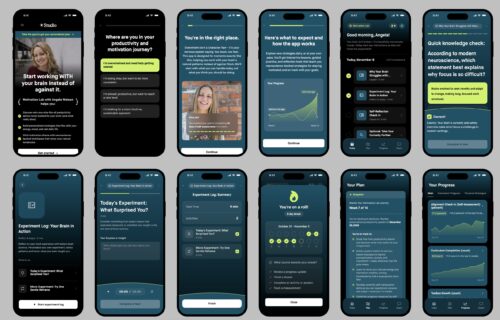
If you can relate to what Andrew’s saying about being a high achiever who’s struggled with to understand your neurodivergent brain, I have a resource that might be helpful. It’s called Motivation Lab, and it’s a coaching app I created to help you understand how YOUR brain actually works. You’ll get personalized daily lessons from me on neuroscience, productivity strategies you can experiment with, and AI coaching trained exclusively on my content.
Within the app, you can choose from modules covering everything from taming anxiety spirals to building your focus skills to giving yourself permission to rest. You choose what you need, when you need it. It’s perfect for neurodivergent folks or anyone who feels like they’ve tried every system to hack their motivation and productivity, but still struggles with consistency.
Check it out at studio.com/angela.
We talked a lot about educators and adults with ADHD. I’m thinking more now about the classroom setting and students. What’s something that you would change about how schools approach ADHD and neurodivergence?
More time to move. That’s so key. It’s a foundation for anyone with ADHD. You’ve got to go out and move. You’ve got to get your heart rate up at some point during the day. For grownups, there’s sometimes more flexibility with that. But with children, there’s just very little time for recess and moving and self-organizing.
Going back to that Annie Murphy Paul book, a lot of students have executive functioning challenges and sitting and trying to learn organizational strategies just seems really disconnected to what we know.
I remember back at BrainPOP we would talk about, students would watch the movie and then you take the quiz. We loved taking the quiz as a class. You’d get up, you’d put the letter, it was selective response for answers. You’d put A, B, C, and D in different corners of the room. Then kids would have to walk to different sections of the room and argue why their answer was correct or incorrect.
It wasn’t even about whether the answer was correct or incorrect. It was getting up, moving, and having a dialogue about a question. That was actually the intention of taking the quiz that way. More ways we can get kids up and moving and doing stuff, literally just moving their bodies, does a huge service.
Integrating curriculum, these are all bigger ideas which are so hard to do in our current structure. Getting kids to study similar concepts from different entry points throughout the day. A mathematical entry point, an ELA entry point, and a scientific entry point through a kind of theme-based curriculum. To me that was more meaningful because you’re dialing into different modalities or different ways of learning around the same concept.
How you–and your students–can use movement to increase work quality, focus, and creativity
When we talked about the attention patterns and understanding yourself, understanding what’s going on with you, understanding these inner voices, I think it’s really important that kids develop that self-awareness. I’m wondering, what does metacognition look like for a kid who maybe has ADHD or is neurodivergent?
I think this goes back, it’s often starting with emotional entry points. I know SEL is like a four-letter word right now, but going back to that example from the beginning where I give students cameras and just have them articulate why is this thing important, that was an entry point into thinking beyond just the observable into the inner.
“Hey, okay, this is a book that I read on Thursday. It was interesting to me because it was about trucks and I like trucks and I like trucks because I like to hear big noises.” Okay, you’re getting into some language and some explanation and some whys.
Repeatedly giving opportunities for that helps build this awareness that, “Hey, this student likes reading books about trucks and this student likes looking at grasshoppers,” and then you’re beginning to also understand others. There’s a lot of language that happens there. There’s a lot of self-awareness that happens there. There’s some emotional regulation in thinking about why you like or don’t like things and seeking some whys.
We can do that from an early age with repeated questioning about it. With books that illustrate, if we’re doing read-alouds or videos that explain things, we can center a lot of that work. That’s a huge piece of helping build the metacognitive self-awareness.
I think a lot of teachers are getting diagnosed as adults. I’ve heard lots of women in particular diagnosed in their forties. It takes a long time because ADHD in women sometimes manifests differently than ADHD in men. I wonder what you would tell someone who’s realizing now that they’re neurodivergent or they have ADHD and they’re trying to figure out what this means for their teaching career.
For people that are diagnosed as grownups, I often start with congratulations. This is the moment. You’ve been making excuses forever and now this is an explanation, and it’s lovely to have an explanation.
Often people will come with even a bit of excitement or relief. “Thankfully, there’s some explanation for all of this.” There’s a moment of growth that happens because of that energy.
This is one of the challenging things that happens for people over time. The initial diagnosis, the relief and the explanation helps build some energy and some hope. There’s a lot of exploration that happens. “Hey, what does this mean? What does this look like? What are the symptoms? How can I help manage and treat this?” Then you open up this cornucopia of ways to manage and treat it and you start being like, “All right, I’m going to dive into it and do it.”
Then the energy and excitement and some of the challenges that come with doing that begin to taper, and there’s a dip. The dip is the moment where you’re like, “Just because I know it doesn’t mean it’s going to go away or be totally treated.” This is where the mindset shift happens.
I love the language of Carol Dweck and growth. We’ve got to break down this big thing that explains so much from your history into some smaller component parts and begin the process of going against what your brain wants to do, which is to fix everything all together all at once. Let’s break it into smaller pieces and just try experiments, because it’s all experimenting. It’s all scientific method and trying things out and being attentive to what comes up when you try things out.
Recognizing that something may work sometime, it may not work another time, and that’s okay because at least you’re working towards some form of management.
Being with people in those moments of massive discomfort about themselves and about that voice and just taking the moment to be in it and to not run away from it or try to fix it all the time is also a really important piece. Because so many of these negative voices or negative feelings that we’ve had, we’ve repressed, suppressed, turned into just self-image. We need to refamiliarize ourselves with that in a more dexterous way.
We need to be with it differently, and it takes a different approach to being with it differently. That can be through meditation. It can be through therapy. It can be through conversation with someone you trust. It can be through writing, journaling. There are all sorts of ways. They’re not all going to work all together all at once, but recognizing that I need to reframe and think about growing through this self-perception.
A lot of the work I do outside of ADHD is around adaptive leadership and this concept of evolution. The beliefs and behaviors that served you ten years ago to get you to this point in your career may not be serving you anymore. As you think about those beliefs and behaviors, what do you want to keep? What do you want to start? What do you want to stop?
Being a bit more deliberate in your frame because you’re beginning to understand there’s a system at work here and this neurodivergence is a pretty big piece of that system. There may be things that are worth keeping that still serve you, but the white-knuckling may not be. So I want to stop that. It’s confusing. “Hey, that really served me, and now it doesn’t. But I still have a thousand responsibilities. So how do I stop white-knuckling and still manage these thousands of responsibilities?”
Part of the job as a coach is to hold people as creative, resourceful, and whole and creating a space for them to come up with some ideas for trying. Because the same thing about ADHD is you’re often pretty good at innovating or thinking differently or being creative. But when you’re at the bottom of Maslow’s hierarchy of needs and you’re just trying to scrape by, it’s very hard to access that mindframe that you’re actually pretty good at but you just haven’t accessed enough because you’re white-knuckling all the time and just trying to survive.
Creating a space where you can actually begin self-trusting is a large part of the work that a coach would do. Because again, there is this creativity in there. There’s a reason ten to fifteen percent of the population are diagnosed as ADHD, and this kind of neurodivergence, because there’s some adaptable value to it.
They say the hunter-gatherers, the people that would go out farther were the ones with ADHD because they were more impulsive and more risk-averse because they’re just going and following and doing it. They could bring back the biggest steak for dinner.
There’s even some theories, and I don’t know where they’re based from, so I don’t want to spread misinformation, but there is an idea that many of the people that came to the Americas from Europe, mostly from Europe because people that came from Africa were not coming by choice, there may be a higher incidence of ADHD in the US because the people that came here were more risk-tolerant. They could go and do things and be impulsive and try out things. People who were less that way stayed home or stayed where they were born.
It’s a theory. Again, I don’t know the origins of it.
I’ve read that before, and it makes sense when I think about the character of our nation, the types of people who chose to immigrate here and what personality traits would be required. Who would stay versus who would leave, who had that ability to separate from their home, their tradition, their way of being in hopes of something new. That’s a really distinct personality trait. If you think about how many of our ancestors had that in them, yeah, it shapes a society for sure.
The movie The Disruptors is about children with ADHD. It’s pretty well researched and well done. It talks a lot about all of the business acumen that people with ADHD have, because there are a lot of CEOs and people in charge of organizations that are neurodivergent in this way and have been very successful because they’ve set themselves up in an environment where that is an asset and not a liability.
Yeah, I’ll have to check that out. So I’d like to close out with a Takeaway Truth, something that you want educators who are listening to remember or to do differently after this conversation.
We’ve talked a lot today around hearing those voices and reframing and thinking about things differently. In a lot of the adaptive leadership work I talk about, we discuss this concept of getting on the balcony.
Getting up on the balcony is this ability to get off the dance floor where you’re doing things and taking actions to get up there and take a look at what’s going on on the dance floor. What’s all the stuff that’s going on?
Let’s get up there and let’s have some multiple interpretations of what’s going on. This is helpful for students you’re working with. It’s helpful for yourself. Some interpretations of what’s going on may be very comforting. “Oh, this is my ADHD diagnosis, and that’s why I’m really struggling with activating.” And some of them may be more challenging, which is where some of that self-critic may be truthful.
But having at least three interpretations of a context is a way of making better sense before you leap to action. There’s some data, there’s some information, there’s something happening. Let’s get up there, try to have at least three interpretations before we decide what to do. Because just that process of thinking about multiple possibilities or multiple truths that could be about whatever is happening is a really helpful habit of mind as you’re going forward in managing ADHD and managing life in general.
You don’t want to get stuck in the “what do I do” interpretation. You can get paralyzed by that. But you need to get to a point where you’ve done a few interpretations of what’s going on, then you take action, and then you see what happens. That then serves you back more data, which you can begin interpreting or using to interpret the next situation.
Getting on the balcony and taking a step back when we want to leap to action is a really helpful thing to do. We always talk about, “Oh, take a beat. Just take a moment.” Take a moment is the first step. Then take a couple of interpretations. That can also become a habit of mind. And then we take the action.
I see this as a parent of two young children. I’m constantly seeing something and leaping to action. I’m like, “No, there are many reasons for people behaving this way. I need to recognize, hey, what’s their agenda here? Why am I leaping to action around my agenda? How can I accommodate their agenda? Oh, but I don’t want to accommodate their agenda too much because this is something they’re working on.”
Taking that beat, thinking a little bit before leaping to action. Because the leap to action is status quo. The interpretation and trying something different is development and evolution. That’s where we want to be, encouraging ourselves to go to be better and to get the outcomes that we desire and to make better meaning.

The Truth for Teachers Podcast
Our bi-weekly podcast has received over 1,200 five star ratings + 9 million downloads. You can support our work by subscribing in your favorite podcast app for free!
Explore all podcast episodes


Angela Watson
Founder and Writer
Sign up to get new Truth for Teachers articles in your inbox

OR

Join our
community
of educators
Share ideas or get advice via our social channels.


