


Mindset & Motivation, Productivity Strategies, Podcast Articles | Jan 1, 2026
It took me years to realize I’m not lazy. I’m neurodivergent.

By Angela Watson
Founder and Writer
It took me years to realize I’m not lazy. I’m neurodivergent.
By Angela Watson
I used to think that I was inherently lazy.
Growing up, every report card comment and parent conference involved my teachers expressing some version of the following:
- “Angela is smart, but not working to her potential.”
- “Angela needs to focus and apply herself.”
- “Angela is a capable student but does not put forth effort.”
- “Angela could do the work if she wanted to but she appears lazy and unmotivated.”
I shared a little of this story back in episode 163 of the podcast, and how I was labeled as gifted at first, and then diagnosed with a learning disability in math:
Now as an adult, it’s always felt like doing normal daily tasks required a herculean effort for me. Despite everything I’ve accomplished over the years, I still felt like something was wrong with my motivation and focus. I couldn’t understand why I felt inconsistent and unfocused when everyone else seemed to just… do the thing.
It’s been a long journey in understanding that I am a neurodivergent person.
I was diagnosed with bipolar disorder when I was in my early 20s, so that part I’ve understood for awhile. I had a massive depressive episode in my third year of teaching and had to take a couple of months off, and a sub took over my classroom. As a teacher, you know the stress of being away from your students, and the fact that I literally could not teach tells you how hard it was for me to do basic things.
But, the term “neurodivergent,” meaning your brain works differently than a neurotypical brain, wasn’t yet in the common lexicon. I thought of myself as having mental health issues, which is a very different framing.
So I was on medication for a long time, and then discovered Cognitive Behavioral Therapy, or CBT, which you see all through my podcasts and my book, Awakened, Change Your Mindset to Transform Your Teaching. I went off medication for many years in large part because I wanted to get pregnant. After it was clear that wasn’t happening, even with fertility treatments, I made the choice to go back on an SSRI. You might remember me talking about that on the podcast a few years ago: the anxiety from the pandemic and schools switching to remote learning and all of that was so extreme for me I really needed to be medicated again.
I continue to take an SSRI which helps with serotonin regulation, and practice mindset and thought work, and I’ve felt really stable over the last few years.
But, I have always lived–and might always live–with unpredictable levels of motivation. Consistency is just really hard for my brain for reasons that might be part of bipolar, or genetics, or my personality, or the society we live in, or any combination of factors.
In my attempt to have consistent motivation and energy levels, I feel like I have tried every productivity system, hoping each one would be the answer that would finally fix my scattered brain.
Here’s what I discovered: there’s no single system that works for everyone, or even for the same person every day.
For over two decades, I’ve been obsessed with understanding what truly drives productivity and motivation in real life.
I’ve guided more than 65,000 educators through my 40 Hour Workweek programs. And through my podcast, books, and courses, I’ve helped hundreds of thousands more build flexible systems that work with their natural rhythms. You’ve heard me tackle these topics of time and energy and productivity and motivation from so many different angles.
That obsession led me to create my Finding Flow Solutions curriculum, which I started in 2022 and finished up in 2025. It took awhile, partly because it’s for K-12 and therefore a massive project, but also, that inconsistent productivity I’ve talked about. I can create sporadically and intensely for awhile, and then nothing at all. So I always built in lots of margin for myself so I don’t miss deadlines, because I know that if something should take 5 solid days of work, it might take me 3 days, or 15.
So Finding Flow Solutions was released on a (generously-timed) schedule, and is finally complete now. It’s a neuroscience-based program for K-12 students to help them manage their time, energy, and focused attention. I want to equip classrooms with these tools so the next generation never has to feel like failures for learning differently, or having different internal rhythms for productivity.
As I was completing Finding Flow, I kept thinking about how to take the curriculum and make it something for teens, college students, and young people to do on their own, without a teacher guiding them through it.
What kind of resource could I create for parents that would help their young people push themselves through difficult tasks and build resilient skills?
And what about adults?
Not just teachers, but all adults who’ve ever felt like I did, like something was wrong with them when really, they just needed different tools.
But I couldn’t figure out the format.
I thought about a journal, but a lot of the types of kids who will use a journal are not the types of kids who need this kind of support. Same thing with turning it into a book. That felt too passive, and I want folks really engaged and experimenting with strategies. Same thing with creating a course. People who need a course on motivation may not be motivated enough to follow through and take the course. Nothing felt right. I couldn’t crack how to make the concepts in Finding Flow accessible and personalized enough to really meet people where they are.
Then Studio.com reached out and asked me to be part of their flagship program for coaching apps. And I was like, “Oh, this is it! This is the format that these folks need, because it’s so personalized and easy to do.” It has built-in accountability. And there are so many people who find that when they’re stressed or struggling, using AI is less intimidating and more accessible than talking with a human.
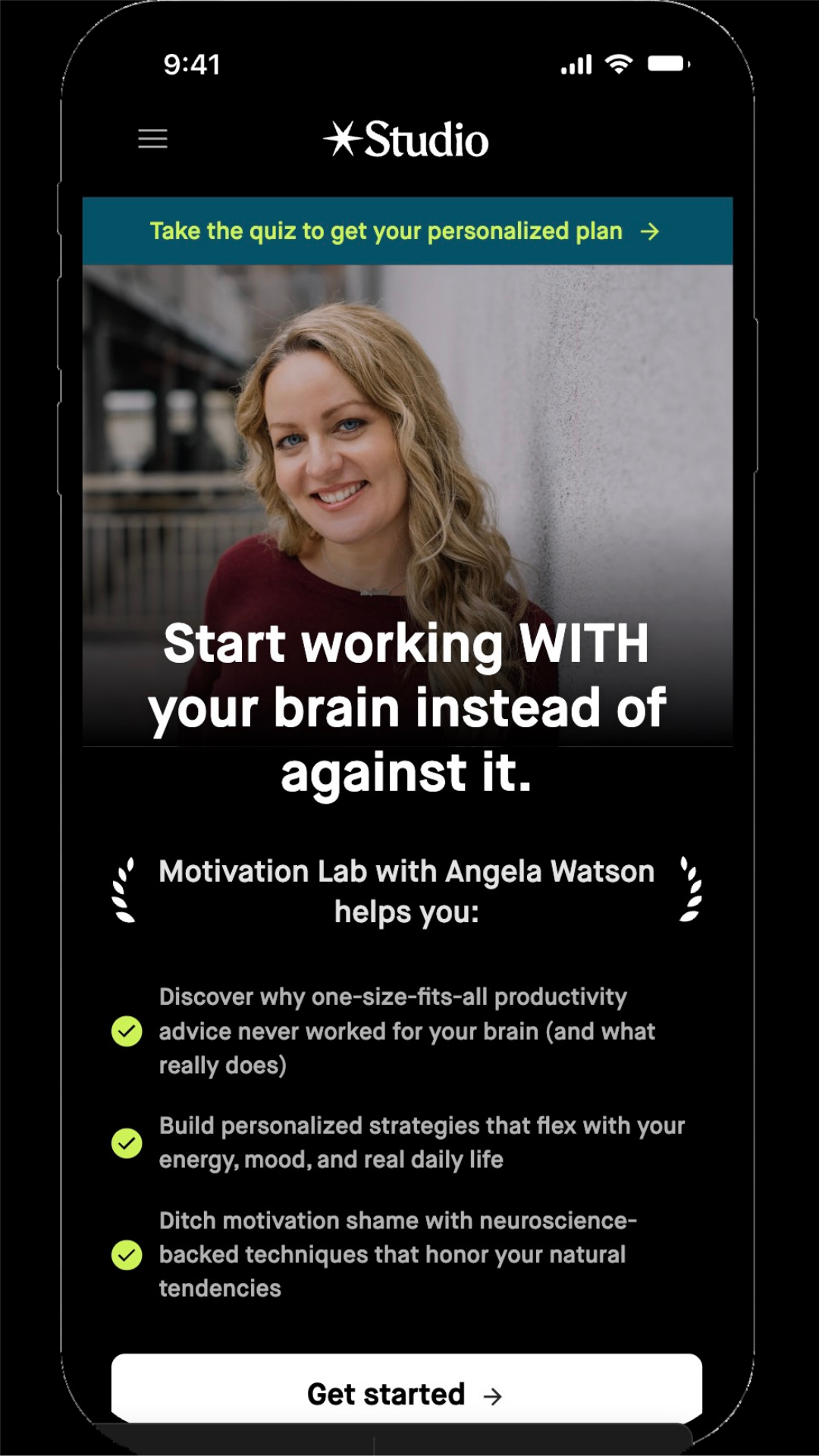
So, I’m introducing Motivation Lab with Angela Watson.
It’s a coaching app that helps people unlock their productivity and motivation using neuroscience. I created it to give you (and the folks you care about who struggle to stay motivated) what I wish I’d had years ago. I would have benefited so much from an app that coached me through each day with strategies tailored to how my brain is actually functioning in the moment, not how I’ve been told it should.
The core idea is this: Your motivation isn’t broken. You just need the right toolkit to unlock it. You need different strategies for different days and moods and tasks, so you can choose what works in any given moment. There is no one right answer, or one strategy that will always work.
You’ve heard me talk before about approaching productivity as an experiment? That’s why I called it the Motivation Lab: it’s like a laboratory where you can test things out, chart the results, and iterate.
Let me tell you how it works.
Every day when you open the app, you see a personalized set of activities designed just for you. This might include a short lesson teaching you a neuroscience principle or productivity strategy. These are 3 to 7 minutes, and they’re in video, audio, or text format.
The app also gives you guided practices and exercises, things like a timed Pomodoro session, or a meditation, or a visualization. These help you actually apply what you’re learning. And here’s what I love: you can experiment with different strategies and log how they felt. Over time, you’re building your own personal toolbox of what actually works for your unique brain.
There are also daily or weekly reflection check-ins where you track your motivation, energy, and wellbeing. And this is where the AI coach really comes in. The AI analyzes your responses and gives you immediate, personalized feedback. It helps you notice patterns. It reminds you that fluctuations are completely normal. It celebrates your wins and helps you reframe setbacks without shame.
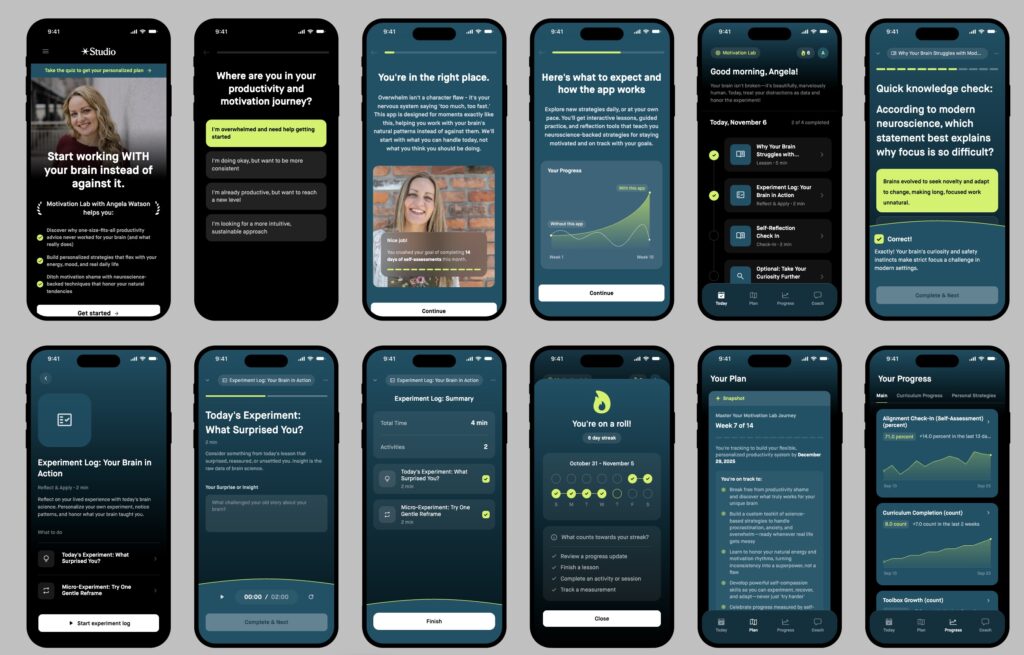
The app has 29 different modules I’ve created and the AI will serve up what you need, when you need it, with your input. If you’re feeling overwhelmed, maybe you start with Reset When Overwhelmed or Tame Your Anxiety Spiral. If you’re struggling with focus, maybe you explore Build Your Focus Skills or Take Control of Your Phone Habits. You have total control over what you learn and when.
And I want to be really clear about the AI piece, because I know that can feel a little uncertain for people. This is not like just chatting with a random AI bot.
The AI in Motivation Lab has been trained exclusively on hundreds of pages of my content. So when you’re interacting with it, you’re getting my voice, my approach, my strategies. You’ll watch videos of me teaching. You’ll listen to audio of me guiding you through exercises. You’ll read my words. And the AI is there to help personalize that experience to your specific needs in the moment.
So that’s really the power of this. Rather than just turning these folks over to a regular AI who knows what data that’s even been trained on or how safe that environment is, this is a special, unique place that has been trained on my information and my advice.
I think this is the best version of blending AI power with human power. It’s still a uniquely human experience, but with supportive AI that makes it available to you 24/7, remembers your entire history, and tailors every conversation to your unique personality and needs. That’s something a human couldn’t do alone.
Within the app, each day’s activities are designed to take about 10 minutes, but you can do more when you’re motivated or skip things when you’re low on energy. You’re never pressured to maintain a streak. You can set weekends off if you want. The app is designed to be flexible because that’s the whole point. Flexibility is actually your superpower when it comes to sustainable productivity.
Now, here’s where I want to talk about who this is for.
Yes, educators can absolutely use this. But Motivation Lab isn’t just for teachers. It’s for anyone who’s tired of being told they’re lazy or unmotivated when the real problem is that no single method works for everyone. It’s for neurodivergent folks who are done forcing themselves into rigid productivity boxes. It’s for busy professionals, students, parents–anyone who wants to understand how their brain actually works and build strategies that honor their natural rhythms.
And this is where I want to ask for your help.
You might be thinking, OK, that sounds good, but I don’t need this enough to pay for it, or I don’t have the money right now.
And that’s totally fine. But here’s something I would love for you to do. If you want to support my work, think about someone you know who might benefit from this.
Maybe you’ve told them about my work over the years, but they’re not a teacher, so nothing I had created was exactly right for them. Maybe you read Fewer Things Better or Awakened. Maybe you took the 40 Hour Teacher Workweek and you thought, Wow, I know people who are not educators who need this stuff. Motivation Lab could be for them. Would you recommend it to them?
I also want you to think about students and parents. If you teach at the high school or college level, if you’ve sat in a parent conference with a caregiver who was at their wits’ end because they just don’t understand how to motivate their 13-year-old or young adult, maybe it’s even a young adult in your family, maybe it’s your own child, and you feel like they have such a hard time putting down the phone and getting to work, or whatever the struggle is, and they’re not listening to you or their parents. They need a judgment-free zone to really explore this. Maybe they’re even someone who already likes to use ChatGPT or another AI as a friend or therapist or someone to talk to. Would you let that person know about this app?
Because that’s really what makes this so valuable. If you’re working with students, young adults, or anyone who’s struggling with motivation and feeling harsh on themselves, they can access this judgment-free zone where they’re getting my guidance, my strategies, but in a format that’s available whenever they need it and adapts to their unique needs.
So if this is not something that you want or need or can afford, but you love the concept and you know someone who could benefit from this, it would mean so much to me if you would tell them. I really feel like this is a resource that folks should learn about through word of mouth and recommendations. And so many of you listening to this are in positions where you’re working with people who are unmotivated, people who are struggling, people who aren’t meeting their goals, people who are really harsh on themselves, people who don’t understand how their brains work, people who are neurodivergent and feel like a failure because they can’t just make themselves do the thing like everybody else. So I want you to know that this resource exists. You can tell people, “I haven’t used it myself yet, but Angela’s helped me with my own motivation and productivity, or helped me support my students with their motivation and productivity, and there might be some good stuff here. Check it out.”
Thank you so much for considering sharing this with people who need it. I really appreciate your support, and I hope this becomes a resource that helps a lot of people unlock their motivation and start working with their brains instead of against them.
The Truth for Teachers Podcast
Our bi-weekly podcast has received over 1,200 five star ratings + 9 million downloads. You can support our work by subscribing in your favorite podcast app for free!
Explore all podcast episodes


Angela Watson
Founder and Writer
Sign up to get new Truth for Teachers articles in your inbox
Discussion
Leave a Reply
OR

Join our
community
of educators
Share ideas or get advice via our social channels.


Hello Angela,
I’m interested in receiving more information about motivation lab that you mentioned in your recent pod cast. I also am neurodivergent and have worked with an ADHD coach and tried unsuccessfully to implement strategies for productivity. I would like to send information to other people and parents when I have a clearer understanding of the program.
Sincerely,
Belinda Aguiñaga