


Equity Resources, Mindset & Motivation, Podcast Articles | Nov 2, 2025
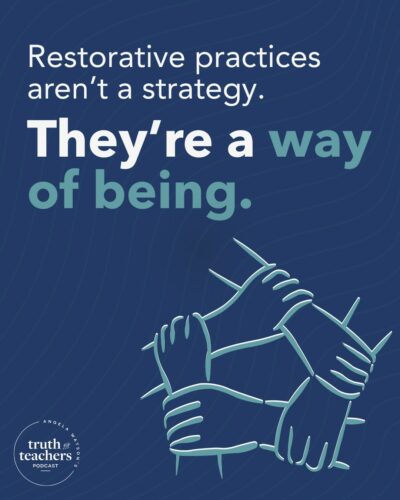
Restorative practices aren’t a strategy. They’re a way of being.

By Angela Watson
Founder and Writer
Restorative practices aren’t a strategy. They’re a way of being.
By Angela Watson
Restorative justice has gained popularity in schools—but it’s often misunderstood, misapplied, or implemented without the deep work required to make it meaningful.
In this powerful conversation, Marisol Revucha shares why so many educators feel disillusioned with restorative practices and what needs to shift for true transformation to occur.
Marisol Quevedo Rerucha is the author of Beyond the Surface of Restorative Practices and the CEO of Heartset Consulting Group. A former teacher, principal, and district leader, she now supports individuals, communities, and systems in building high-trust, equity-centered spaces. Marisol leads with authenticity and vulnerability, helping others create cultures of connection, voice, and healing.
Together, Marisol and I explore what a restorative way of being looks like, how to build a classroom culture rooted in belonging and accountability, and why self-compassion is a foundational part of this work. Marisol also shares her personal story of healing, offers real classroom examples, and closes with an unforgettable metaphor about facing life’s hardest moments with courage and community.
Whether your school is fully immersed in restorative practices or you’re just starting to explore what it means, this conversation offers both heart and strategy. You’ll walk away with a clearer vision for what’s possible—not just for your students, but for yourself.
Topics include:
-
Why restorative justice often fails in schools
-
How to build a culture of repair and accountability
-
The role of self-compassion in restorative work
-
Real-time responses when students act out
-
Restorative practices for staff—not just students
-
“Being the buffalo”: facing the storm together
Listen to episode 337 below,
or subscribe in your podcast app
Sponsored by Mia and Tiago Books
Why Restorative Justice Fails in Schools: It’s Not Just a Strategy—It’s a Way of Being
ANGELA: Marisol, let’s start by talking about the elephant in the room. Restorative justice has gotten a bad reputation in some circles. There are teachers who have given up on it, and schools that have decided, “This doesn’t work. We’re going back to punitive methods of discipline.” Why do you think that is?
MARISOL: Because we see it as just another thing to do. We treat it like a training we attended, a set of protocols from a book we read. What we’re not doing is embracing it as a way of being.
When you’re restorative—and this applies to any kind of equity work—you have to be the work. I know the word “equity” is a charged term right now in our country, but if you are truly committed to equity, inclusion, community, belonging, or healing, then being restorative is a way of life.
It got a lot of hype at first because, like we often do in education, we saw it as a silver bullet. That magical fix that’s going to solve everything. Fix the kids. Fix the culture. But restorative work has failed in many places because we viewed it as something external—”That’s the restorative classroom,” “That’s the restorative teacher,” “That’s the restorative assistant principal”—instead of making a community-wide commitment.
We haven’t defined what it really means to be restorative: believing in relationships, acknowledging that we all bring our full humanity to school each day—our pain, joy, love, and burdens that are sometimes too much to carry.
Another big reason implementation fails is because systems—meaning school leadership—tell teachers, who are on the front lines: “Go do this work. Be restorative. Build relationships.” But they don’t give teachers the time, space, or support to do it. And they’re not doing it for the staff themselves.
The adults in the system need this just as much as the kids. In fact, I believe all workplaces need this—an acknowledgement of our humanity.
When we build spaces for authentic human connection, when we take off the professional mask, when we are vulnerable and show up as our full selves—that’s when real connection happens. And when you feel connected to your coworkers, you’re more likely to work through conflict or difficulty. You see them as human beings, not as adversaries.
Research shows that high-trust organizations are more productive. But even more than that, people are happier and healthier when their workplace gives them time and space to connect authentically.
And that has to come from leadership. The people in charge need to model authenticity. They need to say things like, “I don’t know,” “I’m sorry,” or “I need help.” We can’t treat restorative work as a checklist item. It’s not something we do. It’s who we are.
Why Educators Need Restorative Practices Too: Modeling Humanity for Staff and Students
Yes! I really love your point that the staff need this just as much. A lot of times, that’s where I see the resistance. It’s like, “I’m expected as a teacher to listen to students, help them repair harm, and walk them through all these steps… but when I mess up? I just get a reprimanding email. Or the entire staff gets scolded for something one person did.” We’re not shown the same level of care and consideration we’re expected to give to our students.
And it’s not modeled for us, either. This is a school-wide culture shift—it’s not something you do. It’s not a tool you pull out when there’s a problem. It’s a way of showing up. It’s a way of being.
Our system wasn’t created for this. The world we live in wasn’t built for restoration, for belonging. And what I’ve come to understand is that in order to truly belong with others, we have to first do the work of belonging with ourselves.
The reason I know the system wasn’t designed for that is because of how much it divides us. It denies us our humanity. I always say—there are things we were sold that we bought. Maybe it came from society, culture, family, religion… but these messages, these beliefs we’ve internalized, they deny us our full humanity.
Here’s one example. And I’ve gotta thank Millennials and Gen Z, because I think they’re helping shift this. But what happens when someone gets emotional at work? When someone cries?
They apologize.
Exactly! We apologize for having human emotions. We’re so conditioned to worry about someone else’s discomfort that we shut down our own expression. But emotion is a gift. Feeling gratitude, feeling joy, sharing tears—that’s human. But our society doesn’t teach us that.
We’re also taught that when we go to work, we need to put on a “professional” mask. Don’t share too much. Don’t let people see your truth. And sometimes, we’ve had that vulnerability used against us. We’ve learned not to trust.
Yes. But when we do that internal work—when we stand in our truth, offer our heart, show up whole—we’re doing it for us. Not for validation. Not to manipulate. We do it because it’s who we are, and we want authentic connection.
Exactly. When we give from a place of wholeness, when we receive from that place too, we’re not trying to get something out of someone. We’re just being in community with one another.
How to create a restorative classroom culture: from just posters to daily practice
So when we talk about being restorative… can you paint a picture of what that actually looks like? We’ve talked about how it’s often misapplied—so what should be happening?
Well, first of all, our system was created to push people out. It was built to center and benefit a few—on the backs of many. And it convinces us that’s okay.
But it marginalizes and harms the very groups it claims to serve. Think about it: students with IEPs, students from the LGBTQ+ community, multilingual learners, undocumented students—these are the groups being pushed out. And we need to actively resist that.
Mother Teresa said, “If we have no peace, it is because we have forgotten that we belong to each other.” That’s what restorative work reminds us. The system doesn’t teach us that—but we can.
So I always say: the work needs to be centered on the individual, the community, and the system. All at the same time.
It starts by getting crystal clear about our purpose—how we want to be treated, and how we want to treat others.
My belief—my life’s work—is rooted in the idea that all of us want to be happy, whole, purposeful human beings. We want lives filled with love, joy, connection, adventure—all the good stuff. And when I ask people, “Is that what you want for yourself and for others?” nobody disagrees with me.
But if we’re not experiencing that kind of life, the tendency is to blame someone else. When really, all we can control is ourselves—how we respond, how we react. That’s where this work begins. That’s the foundation of restorative practice: restoring ourselves first, then our relationships, then our systems.
We also have to identify our beliefs. Every school district, nonprofit, university—they all have a mission statement. But do we actually live by them? Do we keep those values present in our daily decisions?
Because if we don’t, we’re going to stray. And when that happens, harm follows. So we have to get really clear—first as individuals—on what we believe. What do I believe about myself? What do I believe about children? About humanity?
When I’m guiding schools or systems, I always ask: “Okay, you say you believe in kids. But do you believe in your colleagues? Do you believe in people?”
Every academic plan, every student support plan, every professional development session—these aren’t just checkboxes. They should be extensions of what we believe.
And if your mission statement says, “We believe all kids can learn,” but you’ve got a colleague talking about a student like, “That kid just needs to be kicked out,” then you’re in direct contradiction. That’s harm. So the question is: how do we have a conversation that’s loving, respectful, and centered in our shared values?
That’s the work. And it’s work we must do as individuals, in our communities, and in our systems.
Living as a restorative community
So what does it look like to live as a restorative community?
It means making a commitment—individually and collectively—to a clear purpose. A shared understanding of what we believe about ourselves, about each other, and about how we want to be treated.
And clarity is key. A lot of times you’ll see school posters that say things like “Be respectful.” But respect can mean something different to every person. So we need to be really clear about what that actually looks like, sounds like, and feels like in practice.
The biggest way relationships get harmed? Communication. So we need to build a shared language—what does respectful communication look like? How do we repair when we fall short? How do we maintain connection and grace while holding each other accountable?
We’re not always going to get it right. We’re human. So we need space for reflection and forgiveness.
That’s how you begin to build a restorative culture: by getting clear—first individually, then collectively—about your purpose and values. And then practicing. Holding yourself and others accountable when you veer off course. Using the shared language of your beliefs to come back to what matters most.
So instead of ignoring it when someone says something harmful, you can say, “Hey, we made a commitment to each other. And what I just heard didn’t align with that. Can we talk about it?”
You approach it with love, dignity, and a sense of shared responsibility.
Because here’s the thing—if we’re willing to do the individual work and the collective practice, that’s what creates a restorative culture. That’s what a restorative person looks like.
It’s not about being perfect. It’s about aspiring to be the best version of ourselves—knowing we’ll fall short sometimes, but committing to keep showing up, again and again.
That’s the real work. It’s not just about restorative processes—those are important—but it’s also about how we approach ourselves, how we commit to each other, and how we show up for our communities, including our students.
Restorative justice ≠ no consequences: addressing the biggest misconceptions
That’s the piece I think is missing in a lot of schools—especially in places where educators are starting to give up on the process and feel like it doesn’t work. It’s the respect and accountability you’re talking about.
Because one of the things I hear a lot from teachers is, “At our school, restorative justice means there are no consequences. Kids can say or do whatever they want, and the only response is a nice conversation… then the behavior just keeps getting worse.” How do you respond to that?
Well… that’s not restorative culture. That’s not restorative anything. That’s surface-level.
Real restorative work is deep. It’s not always hard, but it takes time and commitment.
One of the core foundations of restorative practices is that we do things with people—not to them, not for them, and not done by someone else.
A big reason implementation fails is that the decision to adopt restorative practices was made for people—not with them. A district decides, “We’re going to be a restorative school now,” but they don’t build the capacity or get buy-in. That’s where it goes wrong—right at the beginning.
Another issue? We often frame the work through the lens of students only. But this is about people—staff, students, families, the entire community.
And then what happens? Restorative practices become someone else’s job. We push the responsibility onto a counselor, a dean, or a specialist. And when we do that—when we don’t do the individual work ourselves—it opens the door for manipulation.
Let’s be honest: kids are smart. Adults are smart. If people figure out how to say the “right” things to avoid consequences, without real accountability, then the system gets gamed.
So we have to make a decision: What do we believe about behavior? What do we believe about kids? About consequences? About growth?
Because here’s the truth that’s hard for some to say out loud: sometimes what we want as adults is punishment. We want the child to suffer for what they did. And that’s human, right? We’ve all felt that at some point.
Yes. I’ve felt that in my own career—where a student’s behavior felt like a personal offense, and I wanted someone to come down hard on them. I didn’t want restoration. I wanted retribution. How do we unpack that?
Honestly, Angela—it’s not just about unpacking that as an educator. It’s about unpacking it as a human being.
Why are we letting ourselves get so triggered by the behavior of a 7-year-old? Or a 10-year-old? Or even a 17-year-old?
That’s our work. And that’s the hardest part of all of this. Because it requires looking inward. And not everyone is ready for that.
But if we can make a commitment to having grace with ourselves and with others, we can begin to do that work. And once we do, it opens us up to something deeper and more sustainable.
So let’s bring this back to the individual classroom. What does it look like to be restorative? Let’s say it’s an elementary or high school example—like a student just said something disrespectful to a peer. There’s no physical violence, so it’s not a full behavioral referral, but you also can’t just let it slide. What does being restorative look like in that moment?
First, before you even get to those moments, you’ve got to set the tone and environment in your classroom. One of the most beautiful things I’ve seen is how teachers take time at the beginning of the year to introduce themselves—not just as the authority figure, but as a human being.
You say, “This is who I am. This is what I hope we can do together. These are the plans I have. Is there anything I should know about you?” And then—this is the powerful part—you ask:
“Do I have your permission to be your teacher this year?” “Do I have your permission to support you, guide you, and walk with you through this year?”
And when students say yes, they’re making a commitment to you, just as you are to them. That right there sets the foundation for a restorative relationship. You’re creating a space for their voice and experience from day one.
From there, you move into building classroom agreements together. Ask them:
-
What do we believe about our classroom?
-
What do we believe about school?
-
What do we believe about each other?
-
What do we believe about ourselves?
Write those beliefs down. Revisit them daily. Practice them. Model them.
Even in kindergarten, kids can do this. My four-year-old grandson could understand this. The conversations might be shorter, but they’re still powerful. You show them how to say sorry. How to move forward. How to repair.
You can even model conflict as a story. Say, “Hey everyone, I want to tell you about something that happened to me. I was trying to talk to someone at home and they ignored me. It hurt my feelings. Can we talk about that?”
When something happens in class—like a student being disrespectful—you already have a foundation. You can say, “Remember what we said about how we want to treat each other?”
You can also proactively talk about these situations:
- “Have you ever been called a name?”
- “How did that feel?”
- “Have you ever called someone a name?”
- “Why did you do it? Were you angry? Were you hurt?”
Then you acknowledge: this might happen again. We’re human. But what do we want to do when that happens? What’s our plan?
What to do when a student acts out: Real-time restorative responses that build trust
So once you’ve laid that foundation, what do you do in the moment—when a student actually says or does something disrespectful?
If you’ve built that foundation, then you already have something to refer back to. The student knows what the community expectations are. You can say, “Remember our agreements? That didn’t align with what we said we believe in.”
But even if you haven’t built that foundation yet, or if there’s no existing relationship with the student, there’s still a way to move forward restoratively. That’s where your own commitment to humanity comes in.
You might not know this student well. You might feel hurt or disrespected. But you can still say: “I don’t know you, and you don’t know me, but I don’t want to be someone who causes harm to people I don’t know. So I want to check in. Something just happened between us, and I’d like to talk about it.”
It’s about being the kind of person who repairs harm—even when the relationship isn’t strong yet. That’s restorative living.
And when you’ve set up a proactive culture—where students understand how to name their feelings, recognize when they’re dysregulated, and reflect on their behavior—they’re more likely to be ready for that kind of conversation. They might even initiate it themselves: “Yeah, I messed up. Here’s how I want to make it right.”
The hardest time to repair is when the relationship hasn’t been built yet. But that’s when it matters most. That’s when your commitment to humanity has to lead.
Your point is so powerful—about how much more willing kids are to repair when a relationship is already there. But even if there isn’t one, we can still be someone who models how to repair.
Yes. And when harm happens, it’s not just about talking through it—it’s also about action. The conversation helps develop understanding of what the impact was, and also helps uncover the root of the behavior.
Because behavior is communication. It always has a function. Is this child seeking attention? Whose attention? Are they expressing pain?
When we respond restoratively, we’re not just addressing what happened—we’re gathering information to support that student better in the future.
But here’s the part we often forget: we have to offer that same grace and patience to adults. To our coworkers. To ourselves.
Why self-compassion is the foundation of restorative practice: a personal journey toward worthiness
So how does a teacher begin to practice self-compassion? That’s something I talk about a lot. Some educators are already far along that journey, but others aren’t sure what it really looks like. What are some recommendations for beginning steps, especially for someone who feels like self-love is a foreign concept?
I almost want to say—before we even start with strategies—I hope people will sit with that question: Why is it so hard to love yourself?
Why is it easy to love others, to pour into others, to nurture and encourage everyone else… but not yourself?
What were you told? What do you believe about who you are?
If self-compassion feels hard, it’s because there’s a belief you’ve internalized that says you’re not worthy of it. It’s something you were sold, and you bought it. And it’s deep.
I’ve been going through what I call a Phoenix moment—burning down and rebuilding. The last two and a half years have been filled with harm. Harm done to me by people I love and cherish the most. And I had to go on a journey of figuring out what it really means to love, care for, and nurture myself.
I’m still not all the way there. But I’ve realized something core: I’ve done so much work. I’ve been in therapy since 2018. I’ve worked on my ego, my self-esteem, my need to shine, my sense of competition.
And I knew I was a good person. I knew I was worthy. I knew I was impactful. I knew I was loving. I knew I was beautiful. But deep down… I didn’t believe it.
I had opened myself to love, and when I got hurt, I translated that hurt into “I must not be worthy.” I thought, “If someone I love—if even my child—can treat me this way, then I must not be lovable.”
It shattered the last remnants of my core self.
And I couldn’t figure out why I didn’t believe in my worth. But I knew I had to commit to moving through that pain. I had to feel the emotions. And I came out understanding that the love I give others—the magic I bring—I have to give it to myself, too.
I no longer seek validation outside myself. I no longer seek protection from outside sources. That’s childhood stuff. That comes from not being protected as a kid.
So my answer to your question is this: If you’re struggling with self-compassion, start by asking yourself why. Why aren’t you taking care of yourself? Why are you proud of always being “the strong one”? Why do you put everyone else ahead of yourself?
Where is that coming from?
That is so honest and beautiful. And I appreciate that you didn’t give a quick fix. That’s why your book is called Beyond the Surface, right? Because this is deep inner work. It’s not about doing what sounds good. It’s about doing what’s real.
Exactly. We’ve been trained to live on the surface. To say what people want to hear. But that’s not going to get us to joy, health, peace, or purpose. We have to go beyond the surface and into our full humanity.
The way you’re framing this—blending personal development with professional development—is so important. Because we’re often looking for teaching strategies, or policies, or classroom management tips… but what really needs to be worked on is us.
Yes. And I’m just so grateful for the opportunity to do this work and to share my story. Because once you begin this inner work, it starts to feel less scary. You realize: “I can do this. It’s hard, but it makes everything else easier.”
When you’re triggered—whether it’s by a student, a coworker, whoever—you have tools. You can recognize: Why am I feeling this way? What’s really going on?
And you can ask yourself, “What is my goal here? Is it connection? Is it repair?” And then choose your next steps based on that.
Be the buffalo: Facing the storm with courage, community, and self-worth
Before we close, I want to do what I always do—what I call a “takeaway truth.” For the teachers listening who really want to have a restorative heart, what’s something you wish everyone understood about what we’ve talked about today?
I want everyone to know: You are loved. You are worthy of doing this work. You are worthy of being the best version of yourself. That journey—toward your fullest, most beautiful self—is also the most painful and the most joyful.
You are not alone.
There’s a metaphor I love, one that was shared with me by a math consultant named Ed Campos from Kings County, California. He told me the difference between cows and buffaloes during a storm.
When a storm comes, cows run away from it. But eventually, the storm catches up to them, and they’re running with it, suffering longer.
Buffaloes? They run into the storm. They don’t like it. It’s not comfortable. But they run through it, because they instinctively know that’s the fastest way to the other side. That’s where the sun is. That’s where the green pasture is. That’s where the water is.
They don’t run from the hard. They go through it together.
And that’s what I hope for all of us. That we choose to be the buffalo. Even if we’ve had “cow moments,” we can turn around and decide: I’m going to face this storm.
And here’s the part that gave me chills. Right after Ed shared that story, someone asked me, “Do you know where the word coward comes from?”
I didn’t know. But I do know—I’m not a coward. I’m not going to run from myself. I’m not going to avoid my own healing. I believe in what’s on the other side of that storm.
And even when it feels dark—even when we can’t see who’s with us—we’re not alone. The people who love us, who’ve walked with us, even those who’ve passed—they’re still with us.
So my takeaway truth?
Be the buffalo.
Face the storm.
And know: you are loved, and you are worthy.

The Truth for Teachers Podcast
Our bi-weekly podcast has received over 1,200 five star ratings + 9 million downloads. You can support our work by subscribing in your favorite podcast app for free!
Explore all podcast episodes


Angela Watson
Founder and Writer
Sign up to get new Truth for Teachers articles in your inbox


OR

Join our
community
of educators
Share ideas or get advice via our social channels.


