


Education Trends, Teaching Tips & Tricks | Jan 18, 2026
Stay human: Teaching students to protect their brain power in an AI world

By Angela Watson
Founder and Writer
Stay human: Teaching students to protect their brain power in an AI world
By Angela Watson
I want to talk about something about AI that I think a lot of you are feeling right now, even if you haven’t had the words to articulate it yet.
You’re watching your students reach for AI the moment writing gets hard, and something about it feels deeply wrong. You can’t quite put your finger on why, but you know in your gut that something important is being lost.
I’ve been feeling this too. And I’ve been trying to figure out how to talk about it in a way that goes beyond just “I’m worried about what AI is doing to kids’ brains” – because that’s true, but it’s not specific enough to help students understand what’s at stake.
So I’ve been digging into the neuroscience, thinking about my own writing process, and honestly just wrestling with what we’re supposed to do here. And I think I’ve found some language and frameworks that might help you have these conversations with students.
Listen to episode 340 below,
or subscribe in your podcast app
Sponsored by Mia and Tiago Books
(10 FREE sets of curriculum to build entrepreneurial skills in students–valued at $465–are available!)
Here’s what I keep coming back to: Students don’t understand why the struggle of writing matters. You and I know that productive struggle is essential for learning. When students wrestle with ideas, that cognitive friction creates new neural pathways. We get this intellectually.
But some of our students think struggle means they’re failing. And most of our students find struggle uncomfortable and often frustrating. So when AI offers to remove that struggle entirely, of course, they’re going to take it. Who wouldn’t?
And the thing is, I get it. I use AI to help me get from the blank page to something polished. And if someone had offered teenage me a button that would make the hard things easy, I would have pressed it, too. The adolescent brain isn’t wired to think about long-term capacity building.
So the question I’ve been sitting with is this: How do we help students understand what they’re actually missing out on when they use AI? How do we make the invisible cognitive benefits visible?
So let me share what I’ve learned about what actually happens in the brain when a student writes. I mean the cognitive process of translating thought into language.
What happens in the brain when students write
When students write, their prefrontal cortex activates to make decisions about what matters and how to organize it. Their hippocampus encodes memories and makes connections to past experiences. Their motor cortex coordinates the physical act. Broca’s area translates thoughts into language. Multiple regions fire together, creating new neural pathways, which means it’s going to be easier for the brain to work in that way in the future.
So writing is literal brain building. Every time a student struggles to find the right word, every time they delete a sentence and rewrite it, every time they stare at a blank page and force themselves to put SOMETHING down, they’re strengthening cognitive pathways they will use for the rest of their lives.
What students miss when AI does the writing
But when they ask AI to write it, those regions stay quiet. The brain isn’t activated in the same sense.
When you watch a student paste an AI-generated essay into a document, that feeling you have that something’s been bypassed? You’re right. The entire cognitive workout just got skipped. As a teacher, you’re already vaguely aware of this thinking process, but I wanted to outline the actual neuroscience so you have the language to articulate it clearly.
Because here’s what’s been disturbing me, and I think many of you are feeling this too: We’re acting like as long as students can prompt AI well enough to get a decent output, they’re developing a valuable skill. And maybe they are.
But prompting AI and editing its output is a very different way of thinking. When you prompt AI, you’re essentially giving instructions and then evaluating what comes back. And that’s assuming, of course, that students do bother to evaluate what comes back and don’t just copy/paste, and assuming they even have the skills to properly evaluate the output for accuracy and clarity and so on.
In prompting AI, you’re playing the role of manager or an editor, not a creator. There’s some cognitive work there, sure – you need to know enough to recognize whether the output is good or not. But you’re not doing the deep work of organizing chaos into meaning. You’re not forcing your brain to make a thousand micro-decisions about word choice and sentence structure. You’re not building the pathways for translating fuzzy, half-formed thoughts into precise language. You’re not strengthening your ability to hold multiple ideas in your head simultaneously and figure out how they connect.
If writing is like designing a blueprint for a house, that means prompting AI is like looking at that blueprint and pointing out where you’d like changes. Both require some thought, but only one develops the skills of a true architect: a visionary who can create something out of nothing.
Why adolescence is a critical time for brain development
And here’s what concerns me most: During adolescence, the brain is in this incredible phase of development. It’s pruning unused neural pathways and strengthening the ones that get used regularly. This is the time when students are building the cognitive infrastructure they’ll use for the rest of their lives.
If they spend these years prompting and editing AI instead of doing the actual cognitive work of writing, they’re building a different set of skills. They’re becoming good at evaluating and refining AI output. But they’re not building the pathways for deep thinking, original idea generation, and authentic self-expression.
And those pathways are a lot harder to build later. Not impossible, but the brain is most plastic and adaptable in our youth. Students are in this very precious window of time in which the brain is most malleable, and forming these skills is most essential.
This is what I think students need to understand, and frankly, adults who want to see students using AI to write need to understand. Some do, of course–I don’t mean to be condescending. But the frequency with which I hear the question of “Why is it okay for the teacher to use AI and not the student?” tells me we need to have more conversations about that topic. It’s an important question that’s worth grappling with and deserves a real answer.
So here’s what I’ve been telling folks, and maybe this language will help you too.
Why it feels unfair that teachers can use AI but students can’t
Adults who use AI for writing already spent years building those neural pathways. We learned to write in an era where there was no other option. We did the reps. Our brains have those strong pathways. The infrastructure is built. We don’t yet know what happens when young people never bother building those pathways and skip right to producing high-quality writing with the click of a button. It’s never happened before in human history, and those of us who value human thinking, originality, creativity, critical thinking, and brain power are concerned that an entire generation of young people may be our guinea pigs as we uncover the answer, and that’s disturbing.
But there’s another aspect of this brain building through writing in our youth that matters just as much as the cognitive capacity, and this is where I think the conversation gets really interesting.
I know my writing voice. After decades of writing without AI, I’ve figured out how I think, how I organize ideas, what style feels authentic to me. I know when something sounds like me and when it doesn’t.
When I use AI to help draft an email or clean up some clunky phrasing, I’m using it as a tool AFTER I’ve done decades of cognitive work on my own. I’ve also done decades of fact-checking. I have a lot of knowledge and wisdom, and lived experience that helps me flag information that might not be correct. I have a strong sense of, “Wait, that doesn’t sound right, is that really true?” because I’m 47 years old and have intentionally refined my critical thinking skills every day for as long as I can remember. A teenager can’t possibly do that yet at my level–they simply haven’t lived long enough, encountered enough information, thought enough thoughts, or written enough communication.
Now, teenagers really don’t enjoy being told they’re too young to understand things, especially when there are things that they understand about the world that older folks don’t. I don’t necessarily recommend taking that approach in your discussions with kids. I just want to validate it here, with you, because I think it’s important and needs to be said. More years of forming neural pathways makes our brains different.
Students haven’t found their writing voice yet
But the compelling aspect of this that I do think is worth delving into with students is personal voice. I can tell when AI’s suggestions fit my voice and when they don’t, because I have spent years developing that voice.
Our students are still figuring out who they are and how they think. They haven’t written enough to discover their unique voice yet. Being a young person means some of your most important inner work is uncovering who you are, and that part resonates with them. They want to be encouraged to discover what they like and what they don’t, to experiment with their own personal style and opinions and beliefs, to try different activities and hobbies and ways of learning and seeing what resonates. Humans naturally gravitate toward self-individuation and self-expression during the pre-teen and teenage years, and it’s really healthy.
How AI can interrupt the development of voice
So here’s the thing with AI. If young people never learn to play an instrument or sing and have AI do those things for them, it’s not exactly clear how they would ever find their own musical style. It will be heavily influenced by AI, and they’ll be skipping over the struggle and practice that leads to becoming really proficient in music. Same with graphic design. And same with writing. Maybe even more concerning with writing.
If young people never develop their own writing style and allow the style of AI to become their default, they might never find their own unique voice.
When students use AI as their default, they’re skipping the process of discovering who they are as thinkers and writers. They’re letting a machine’s generic voice become their substitute voice before they’ve had a chance to develop their own. And I think this is what we need to help students understand. They’re not being left out of some adults-only privilege. They’re being asked to build something that will be uniquely theirs for the rest of their lives. That’s not something you can outsource and come back to later. The time to build it is now.
And here’s the thing about voice: you don’t discover it by reading what other people write, or what AI generates. You discover it by writing badly, revising, trying different approaches, figuring out what feels true to you. That process takes time, and it takes a lot of writing.
I see it as an author. In 2022, when I wrote the second edition of my book, “Awakened: Change Your Mindset to Transform Your Teaching,” more than ten years had passed since the first edition, and I could see the difference in my original writing. Ten years prior, my writing was clunkier, stiffer, with more awkwardly constructed sentences and less flow between ideas.
This matters to me, of course, because I’m a writer, and people who don’t write things and use the written word to express ideas for a living might not care as much.
Writing isn’t just showing thinking — writing is thinking
But the final piece here is about what writing really is about. Sometimes we talk about writing like it’s a way to show your thinking. But that’s not quite right.
Writing IS the thinking.
How many times have you started writing something and discovered halfway through that you actually believe something different than you thought you did? Or you were explaining a concept and realized mid-sentence that you didn’t understand it as well as you assumed?
That’s because the act of putting thoughts into words forces a level of clarity and organization that just thinking about something doesn’t require.
The risk of letting AI shape students’ worldviews
And that’s what we’re noticing when students turn in AI-written work. They’re not just skipping the writing. They’re skipping the thinking. They might read what AI produced and think “yeah, that sounds right,” but they never did the cognitive work of figuring out what THEY actually think. Even in nonfiction writing, the author chooses the lens from which to view things, decides which angle to take, determines which facts are most important to report, and which don’t warrant being emphasized.
It’s that piece that is so detrimental for young people to outsource their writing and, therefore, their thinking to AI. This is particularly true given the bias and politics and worldview influencing AI output–meaning, the perspective you get from Elon Musk’s Grok may be different from what you get from Anthropic’s Claude. It’s dangerous for students to ask a bot to summarize the causes of the American Civil War, for example, and assume it’s accurate, unbiased, or even aligned with what the student themselves have learned and understood. If you’re just copy/pasting from AI, you might not even agree with what the bot said or give yourself the opportunity to consider if you agree.
This is what I want to invite students into considering. This skill set matters beyond school. The future belongs to people who can think clearly, connect disparate ideas, see problems from multiple angles, and articulate solutions. The future of our society and planet depends on what our young people think, know, believe, and do. You can’t develop those skills by consuming and regurgitating AI-generated content. You develop these skills by wrestling with ideas yourself and practicing ways to express your views.
Here’s the last thing I want to offer to you for consideration, and it’s the part that I think hurts the most, when we see students submit work written by AI.
You can tell which assignments have AI involvement not just by the telltale bot language, and not just by the ones that seem too perfect, too advanced, or too formal. You can tell which assignments were written by AI because they have no soul.
This is difficult to explain, but it means the writing has no quirks. No unexpected turns of phrase. No moments where the student’s personality leaks through. No evidence that a real human with real experiences and real feelings had sat down and tried to capture something true. The tone, style, and vocabulary of every AI-submitted paper sounds eerily similar.
This is because AI can mimic competence, but it can’t mimic humanity. It has no lived experience to draw from. No memories, no feelings, no perspective shaped by actually being in the world.
What makes human writing irreplaceable
And when humans write, we’re not just conveying information. We’re building a bridge between our inner world and someone else’s. We’re saying, “This is what it’s like to be me.”
And I think we need to help young people understand that this is not something to outsource. Their voice, their perspective, their way of seeing things is the most valuable thing they have in a world where AI can generate infinite generic content.
Adam Mosseri, the top executive at Instagram, said in an end-of-year review in December 2025 that, “All the major platforms will do good work identifying AI content, but they will get worse at it over time as AI gets better at imitating reality. There is already a growing number of people who believe, as I do, that it will be more practical to fingerprint real media than fake media.”
Mosseri also noted that “Authenticity is becoming infinitely reproducible,” which is a statement that provoked a lot of controversy online. Some folks pointed out that AI is inherently inauthentic, so the statement is false. Others take issue with the paradox of reproducing authenticity: a copy of the original is a copy, no?
I’m not sure how I feel about the idea of infinitely reproducible authenticity. But I do see that we’re at a crossroads in our humanity.
One path leads to a generation of young people who can prompt AI really well but can’t think deeply, can’t write with an authentic voice, and haven’t built the cognitive infrastructure they need for complex problem-solving.
Another path leads to students who understand that AI is a useful tool for certain tasks, but that the work of thinking, the work of finding your voice, the work of wrestling with ideas until they make sense, is fundamentally human work that can’t or at least should not be outsourced, at least not if we value our species as humans.
I think we have a narrow window right now to help students see the value in that second path. And right now, they’re getting mixed messages. They see adults using AI. They see it producing results faster than they can, and better than they can. They feel the pressure to keep up.
What they may not be seeing–or what they may not be valuing enough–is what they’re losing. And I think that’s where we as educators come in.
Teaching students to use AI with intention
Now, let me be clear: I’m not saying students should never use AI. I’m saying we need to be intentional about WHEN and HOW they use it, especially while their brains are still developing.
And I think you probably already sense these distinctions. There’s a difference between using AI to check grammar after you’ve written something and having AI write the thing in the first place. There’s a difference between using it to generate ideas you then evaluate versus accepting its output as your own thinking.
We need to teach students these distinctions. And more than that, I think we need to help them experience the satisfaction of writing well themselves. That feeling when you finally find the right word. When a confusing idea suddenly makes sense on the page. When you read back what you wrote and think, “Yes, that’s exactly what I meant.”
AI can’t give them that. Only the act of writing can.
And maybe that’s the message. Not “AI is bad” but “writing things yourself creates benefits that are irreplaceable and worth experiencing on a regular basis.”
I don’t know. And I don’t know if I want to give that message. I think I’d rather have each student draw their own conclusions and decide on their own approach.
Helping students protect their brain power in an AI world
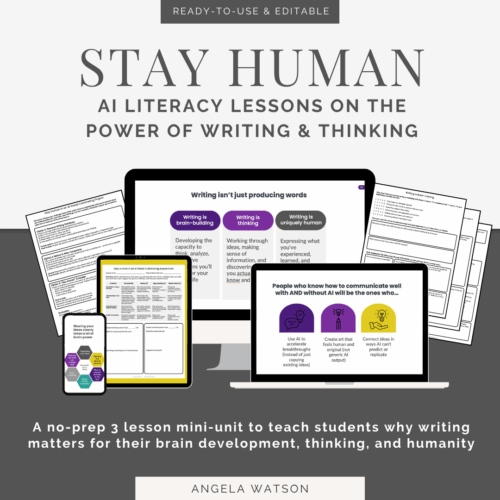
So, I created a mini-unit to help us have these conversations with students. It’s called “Stay Human: Protect Your Brain Power in an AI World.” There are three lessons, about 20-25 minutes each, designed to help students understand the neuroscience of writing, why writing IS thinking, and what makes human writing irreplaceable.
The first lesson is about how writing literally rewires their brains. It addresses that adult versus student question head-on and lets students draw their own conclusions through discussion.
The second lesson tackles the idea that writing is thinking, not just a way to show thinking. It includes practical strategies for when writing is hard, and addresses the “I’m not a good writer so why not let AI do it” trap.
The third lesson is about humanity and voice – what makes their writing uniquely theirs and why that matters.
Each lesson has journal reflections, and there’s a choice board at the end so students can demonstrate their understanding in whatever format works for them.
If you want the ready-made unit, it’s available at shop. TruthforTeachers.com.
But whether you use my unit or not, I hope this episode has given you some language and food for thought as you navigate these issues with your students.
Because I think students need to hear from us that their thinking matters. Their ideas and perspective, their voice matters. That the hard work of writing is building the brain they’ll have for the rest of their lives.
And, I know this is hard and far more complex than what I’ve outlined here. I know some students are going to use AI to do their work, no matter what we do. I know we can’t police every assignment. And I know AI is here to stay.
But I also know that the concern many educators have about what is being lost when students default to AI for their thinking and writing–that concern is valid.
And I’m not willing to just accept that loss without at least trying to help students understand what they’re giving up.
The AI companies are spending billions of dollars in the race to make their tools faster, smarter, more seductive.
Our job is to help students understand what they lose when they take the shortcut. To help them value their own thinking enough to protect it. To help them stay human in an increasingly automated world.
So that’s what I’m working on. And I hope some of what I’ve shared today helps you with the conversations you’re having, too.
The Truth for Teachers Podcast
Our bi-weekly podcast has received over 1,200 five star ratings + 9 million downloads. You can support our work by subscribing in your favorite podcast app for free!
Explore all podcast episodes


Angela Watson
Founder and Writer
Sign up to get new Truth for Teachers articles in your inbox


OR

Join our
community
of educators
Share ideas or get advice via our social channels.


