

Mindset & Motivation, Podcast Articles | May 3, 2026
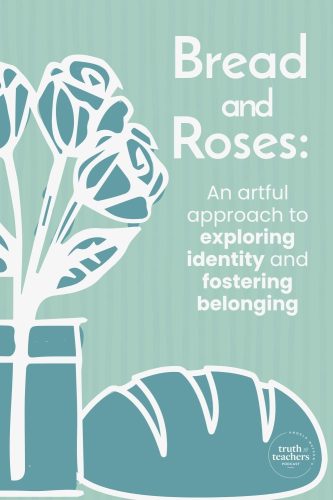
Bread and roses: an artful approach to exploring identity and fostering belonging

By Angela Watson
Founder and Writer
Bread and roses: an artful approach to exploring identity and fostering belonging
By Angela Watson
When the world feels this heavy, this broken, it can seem almost frivolous to focus on art in the classroom.
Who has time to write poems or pause to look at beautiful images when we’re barely keeping our heads above water?
But then I think about what we’re left with if we don’t make space for those moments. If we strip away beauty and creativity and connection, all we have left is the grind. The compliance. The systems that are exhausting us in the first place.
And that’s exactly what my guests today came to talk about.
Rebecca Bellingham and Veronica Scott are the authors of The Artful Approach to Exploring Identity and Fostering Belonging. They’re educators, writers, artists, and the co-founders of Artful Belonging Studio.
And they believe that being artful isn’t extra. It’s resistance, and it’s survival.
Veronica talks about this old political rallying cry, ‘Bread and roses’, which is about the idea that we don’t only deserve bread. We deserve roses, too. Even when things are terrifying, even when the world is broken. We deserve beauty, and so do our students.
So today we’re talking about how to actually do this. What does an artful lesson look like when you have content standards to cover and no time? How do you do cultural heritage months in ways that invite all students in instead of making them feel obligated? And where should teachers start if they want to try this work?
Rebecca and Veronica brought so much warmth and wisdom to this conversation. Read on, or listen in.
Listen to episode 347 below, or subscribe in your podcast app
Sponsored by Retreats
Why art matters more than ever in the classroom
ANGELA: I’d like to start with talking about the why behind your work. So Rebecca, when you reached out to me about your book with Veronica, you mentioned something about the artful being what you called an antidote to many of the capital P problems in our world. And that’s a big statement. So tell us, what do you mean by that? And what problems are you seeing in classrooms that an artful approach can actually address?
REBECCA: I stand by that statement. It’s a big statement. And thank you for that. It’s a beautiful question.
I think the artful helps us pay closer attention to our lives and to our learning and to texts and to our history lessons. And I think about the artful as helping us to cultivate a capacity for noticing, for paying attention and reflecting in ways that build a certain muscle and help us become more expansive in our thinking and our ways of relating, in our ways of understanding the world.
Because if we’re not paying attention to what we’re paying attention to, we’re just consuming uncritically, and we’re sleepwalking through our days. And I know this is a problem in my home, the scrolling and the being pulled back to our devices. With my teenagers, it’s a constant navigation and challenge. And I think we’re all thinking, how can we build and support a new generation of kids that’s willing to pay close attention, to build that noticing and reflecting muscle in their brains and also in their hearts. So that’s a big picture way of thinking about it.
And I’ll give you a little more of a specific answer. And I can’t help but think about the read-aloud practice as a way to talk about it because lots of teachers would say, “Reading aloud is the best, and it’s such an important part of our day”.
But I think about the read aloud as really a moment of artfulness that exists every day in our classrooms and the ritual around it, the way things slow down inside the classroom, the drama of it, getting out the book and settling in to listen in community, and then doing this hugely important work of thinking together, talking together, listening to each other, opening our hearts to the story of someone who might not walk in the world the way we do, or seeing our experience reflected back in ways that help us make meaning and feel affirmed in our own lives.
And this is what the arts do. They open us up. They connect us to each other. They make room for new possibilities. And I really think we all need this. We, adults, need it. Our kids need it. We need these moments of connection that help all of us cultivate the ability to pay attention in a more sustained way to engage in the work of listening to other people’s stories and learning something challenging that you have to grapple with that requires attention, noticing, and reflecting.
So I really think that these artful experiences calm individual and our collective nervous systems, because I think they’re all fraying right now. And I really mean that. I think the arts, and I talk specifically about the read aloud, but the arts in general help us tune in to each other, to ourselves, to the creativity of the world. And all of that feels very restorative and supports wellbeing, which create the conditions for children to learn in the first place.
What an artful approach to teaching looks like
That’s really well said. And I appreciate you giving us that language because I know a lot of teachers see the inherent value in these practices, but it can be difficult to explain to parents, to administrators, to get other people on board. So I think your language there is really helpful. And Veronica, you are Rebecca’s co-author and her partner in this work that you do at the Artful Belonging Studio. Tell me about how the Artful approach works and how you apply it in various contexts.
VERONICA: Yeah, so the artful approach for us is simply put, thinking creatively and thinking about how we can inspire creativity in the classroom and in our students. And we define it a little bit more formally in the book as teaching practices and a leadership stance that are inspired by the magic of the arts and grounded in culturally responsive pedagogy.
And as Rebecca said, the arts deepen our capacity for noticing, for pausing, for reflecting. They invite us to share the story of who we are and to listen generously to each other and to be in community with each other.
And some simple techniques and strategies you can incorporate with very little setup are artful openings. You can think about those crucial moments at the beginning of a meeting or a lesson where people and students are really tuned in to what you’re saying. And think about how you might use that moment to create a bigger impact rather than just diving in. Could you open with a poem? Could you open with a little bit of music? Could you have some creative reflective moment there?
And then the same for the closing as well. Those closing moments are so crucial. Before we rush off to the next thing, how can we create a little community moment together? It might be having every student share out one word, one feeling word, or one line from something they’ve written, and really having that little collective closing reflective moment can just close out the moment a little bit more artfully and leave students with a restorative feeling or whatever the feeling is, an energizing feeling that you want to have at the end of that experience.
Why creativity Is more than “extra”
And something I want to add to the capital P problems question is, I wholeheartedly underscore everything Rebecca said and agree about the power of the arts. That’s so much of this work. We’ve witnessed the power of the arts to open people up and to connect. But one thing we also talk about in the book, we have this line, a community poem is not going to fix our broken world.
And so we also want to acknowledge that when the world feels this heavy and this broken, it can be tough to look towards something that feels maybe frivolous, poetry. But also, if we look back throughout history and look at moments where there was really pivotal change, it’s almost impossible not to notice the link between movements and music or moments of change that were inspired by writers or thinkers who dared to imagine the world differently and write that down.
So we’re thinking about how we can look to that long-standing tradition of civil rights movements and activists who sang and marched and linked arms together and draw from that for our current moment. How can we use our creativity to draw attention to the issues that matter the most to us and lift up our voices together? And how can we teach our students to do the same, too?
I’m really glad that you added that in because I see this a lot in my algorithm on Threads. Threads is my social media community of choice, and I see people there a lot talking about how art and joy are resistance and how it can feel silly to write a poem or paint a painting when things are this dire.
If we don’t do those things, then all we have left is corporations, then all we have left is capitalism, then all we have left is what else is going on in the world. And to be artful is to be human, and holding onto our humanity, finding our shared humanity is so important.
And you’re so right about historically when people have lived through difficult times, art often was what got them through. If we look at even the nineteen twenties for example, we see the rise of the KKK, we also see the Harlem Renaissance, and these things are interrelated, and so I’m glad that you’re pointing this out to teachers that this is not going to fix everything but it’s so important in holding on to who we are.
REBECCA: What you just said actually reflects a line from our book where we say, If we’re not creating or connecting, it can sometimes feel like we’re just surviving. And we don’t want that for our children, or for ourselves, or for ourselves as teachers either. So that’s an important thing to remember.
VERONICA: And I also think about what you said around the Harlem Renaissance and what we’re inspiring is not only activism for this moment, but record-keeping for history. Let’s not forget that now, when we go back to those really horrendous moments in history, a lot of the truth exists in the artifacts that artists created, that exists in the poems that were written about the moment, and children writing in their diaries what they were seeing. These are important skills to teach kids to think like historians and to document what’s happening in the world around them.
How to create artful lessons without extra prep
So you talked about how we can have these opening moments and these closing moments. And I love that because that’s super simple, not taking anything away from the curriculum or the day. And you really both emphasize that this approach doesn’t require extra prep time, doesn’t require special funds, any fancy supplies.
So, Rebecca, would you walk us through a real example of what an artful belonging lesson actually looks like when teachers have content standards they need to cover and they don’t have enough instructional time?
REBECCA: Yeah, I totally get that. And I think the big idea is that it’s really not about an additional lesson. It’s really more about a stance or an approach, a way of the intentionality behind the way that you’re leading something or setting something up, like Veronica talked about, and you just mentioned too, reading a poem to open up a lesson or a day.
And it’s thinking about the timing and the way you’re approaching it. And to be really specific, a very specific example might be when you’re having kids reflect on their thinking or sharing out a line of poetry or a line of writing that they’ve just done, setting it up so that we share in a way that has a little rhythm. And we’re not going to interrupt in between. We’re going to have it be a poem at the end of our lesson, we’re going to share out one line, and it’s going to have a certain rhythm to it, and it creates this artful moment.
And then I also think a lot about the creativity we bring to our read-alouds again, where we can invite children to embody something or repeat back a line or say something in unison. And I’ve done a lot of work where we create little picture book plays where nobody’s memorizing anything, but we’re rereading the story and the kids are acting it out, and they have certain lines they all say together. And maybe we end it with a song, or maybe not, because that might feel like too much, but it’s just adding a little bit of embodiment, a little bit of creativity, turning a pencil case into a basket that has magical yarn in it that the markers represent, being a little bit creative about what you have.
And even with a poem, doing it once or twice more and embodying it, and then maybe performing it. It’s just that added layer, and that added intentionality that I think really elevates things to being a little bit more artful.
Using poetry to build identity and belonging
Veronica, do you want to add to that? Maybe give us some specific activities or picture books, poems, pop culture examples. What are some go-to resources and methods that you like?
VERONICA: Yeah. One poet who continues to give and give, even though we’ve lost the actual poet, her poems feel infinite in their wisdom, is Nikki Giovanni. And her poems work for all ages. They work for sixteen-year-olds and sixty-year-olds, and we’ve used them with all ages. Some of them are so accessible and poetic that they really lend themselves to being mentor texts for students to learn how to express their own stories. We love her poems like The Reason I Like Chocolate and Rainbow Boat, which Rebecca, I don’t know if you want to add something really fun that you do with Rainbow Boat.
REBECCA: Well, I mean, just the idea of we say it and then we really act it out together, and we slow it down, we repeat a line, and littles really love that. And I redo that with lots of poems.
VERONICA: So we’ll take something like Nikki Giovanni’s The Reason I Like Chocolate, which is about her love for chocolate, and invite students to write their own “The Reason I Like” and it can be a thing in their community, it can be the reason I like morning book time at the circle, or the reason I like nap time, or the reason I like gymnastics. It could be a person they want to celebrate in their community, science class, Girl Scout troop. So by centering the work of a black poet, we’re sort of affirming kids who don’t typically get to see themselves in the text, in the canon, and we’re inviting kids of all identities to connect with that poetry and then to learn how to express the things that matter the most to them.
Yeah, I’ll second that choice of Nikki Giovanni. I am not a person who particularly likes poetry, but I discovered her when I was 16. I’m not sure how. It may have been in class, but I ended up reading every single book of poetry of hers because it is just super super accessible. So if someone’s listening to this and isn’t really into poetry or has not heard of her before, that really is a great entry point on so many levels. And to see her body of work change from when she was younger to when she was older. Yeah, that’s really a great go-to resource. Tell me more.
REBECCA: Well, she has these picture books.
VERONICA: She has gorgeous children’s books that you can use as well, illustrated often by Ashley Bryan, who is another artist, who people don’t often know but has a fascinating story. He made puppets and wrote poems for his puppets, and had this gorgeous studio artist workshop off the coast of Maine. He lived on this tiny island for much of his life and lived to be in his late nineties, still creating and doing story time, and saw so much. So I definitely recommend starting with those picture books for children that are also beautiful for adults, as well. The Sun is So Quiet — I think I might get these names wrong — and I am Loved.
So I couldn’t recommend Nikki enough for a place to start if you’re not sure where to start with poetry. I’ve heard so many people say they find her poems accessible and have really found a love for writing their own poetry through the discovery of Nikki Giovanni.
I had the honor of seeing her at what I think was her last stage appearance in Harlem. She did an event at the Schomburg Center. She said it was like her life dream to sing and record a jazz album or gospel album, and she was like, “I can’t sing, but I’m doing it, anyway”. And so I sort of love that spirit of like going out, trying a thing, and trying to be an artist. It’s not really about having the perfect skill set or about doing it perfectly or creating the perfect painting, but really just trying to find a way to express yourself in some creative way. Clearly, that’s resonated with generations that look to her for that inspiration.
What “artful” can look like beyond poetry
What else might that look like besides poetry or music? When people think of artful, I think sometimes they have a very limited scope or a very limited idea, but creativity looks very different in different contexts.
REBECCA: Well, I’m thinking about this hilarious and also kind of groovy thing we did where we showed the telescope.
VERONICA: So this was for a Black History Month experience we did called Look to the Stars, and it was inspired by the long tradition of looking to the stars. From Harriet Tubman to Afro Futurism. Looking to the stars for inspiration, we celebrated black scientists and folks in STEM. And so we read the book, Mae Among The Stars, which is about Mae Jemison, the astronaut, and invited students to write their own My Night Among The Stars poems.
Then one of the experiences we did, which took no materials and very little prep time, was to watch the images created by the Hubble telescope. Those had just been released, and so it was sort of in the zeitgeist, and people are fascinated by it. And so we found a video showing those images, like beautiful photos that the telescope had taken, we put some music on, and we just did 30 seconds of a mindful journey through the stars after that read aloud of Mae Among The Stars.
So there’s sort of a STEM connection there, and also again, low prep materials, and the whole community did it together. That’s what made it like this artful community experience.
REBECCA: We asked them to imagine what they would be doing in space, what they might be seeing in space, what they were noticing, and how their bodies might be moving, and then they used all that sort of internal observations and thinking to write their stories about their nights among the stars.
VERONICA: It was trippy, far out, and fun. It was a really good time. The kids loved it.
How picture books make difficult history more accessible
You know we’re talking a bit about history here: we’re talking about people from history like Harriet Tubman and Nikki Giovanni, for that matter, who have become controversial in recent years.
I think when we talk about teaching honest history and highlighting non-canonical voices, voices from marginalized groups of people, it’s really become a flashpoint for teachers, and some people are afraid to do it because of pushback from parents or administrators.
Even using the words “equity” or “African American” can get them in trouble. So, tell us how to share an artful approach to help teachers navigate developmentally appropriate, honest history.
REBECCA: Well, first of all, teaching honest history is about teaching accurate history so we should just start with that. That’s good practice because we want our children to be informed and tell the whole story that we’ve inherited in our country. I think one thing that really has worked for us that we have found to be a really powerful and meaningful way in, has been to use picture books and children’s literature — not just picture books, children’s literature actually mostly — and read it as adults and think about some of the stories from our history through its lens because it really opens people up.
There’s something about children’s books where we’re kind of all rooting for the character and tells honest history in sophisticated and beautiful ways, especially in the hands of wonderful writers like Heller and Linda Sue Park. I’m thinking about reading Prairie Lotus, which is a really powerful story about conflict on the plains and anti-Asian hate and the marginalization of indigenous people, and really white supremacy. It’s a children’s book, and we read it together, and we really learned a lot.
We were learning for our own self-growth, learning about history. Depending on how much people knew about that particular history, but we were learning about it using a children’s book, which just kind of cools the temperature and really is kind of a way for all of us to engage differently cause we remember what it felt like to read as a child. And to read stories about children, I think we go into it in a different place in our hearts and our bodies and our minds.
So we’re able to have different kinds of conversations and be more open to learning about honest history with this beautiful resource of children’s books. So that’s one thing that has really worked well for us, building community as adults using children’s books. And I think the other thing that’s really important is that we often talk about how we humanize.
You asked about developmentally appropriate honest history, and so that’s really thinking about how we are telling the story in humanizing, again, honest, accurate ways. We talk a lot about humanizing terms; we don’t use the term slaves, we use the term enslaved people. We don’t talk about slave owners, we talk about enslavers. And so it’s just being accurate and humanizing to the specificity of people who were in those conditions.
I think those two tips have really helped us to think about the language we’re using that is accurate and humanizing, and leaning on a resource like picture books to help us enter into conversations and bring adults into the conversation.
VERONICA: One other beautiful picture book that we use, particularly around hard history, which we refer to as the history of enslavement in our country, is the book Born on the Water by Renee Watson and Nikole Hannah-Jones, and illustrated by Nicholas Smith. We use that book because it does all of those things that Rebecca just named. It disrupts so many common myths around enslavement in particular and humanizes the very people at the center of this story.
We open our Chapter 6, which is about teaching honest history with Clint Smith’s wise words of how do you tell a story that’s been told the wrong way for so long. So one way we do that is introducing this fresh work of Renee Watson. And Born on the Water, if you haven’t seen it, is so humanizing in its illustrations and close-up illustrations of beautiful faces and brown skin.
It starts the story before shackles, it starts the stories before enslavement, and it looks at the specifics of communities: the skills and the highly skilled labor that went into the work that many enslaved people did to build this country. And it looks at the love created between families in spite of the horror.
And it’s written in poetry, it’s written in verse, and I think Renee Watson said she wrote it that way because she wanted the poems to be like containers which gives the kids time to process what’s happening, what’s unfolding in the story, meaning you can dip into the first part of Born on The Water — and we often recommend doing that slowly — you can sort of tell that story, give time to notice pause, and reflect, and then you can come back into the story.
You don’t need to overwhelm and tell the whole story in one sitting. I can’t recommend that book enough. There are many others that have been rewritten recently but looking for fresh picture books that really do that humanizing work is a good place to start.
How teachers can create a stronger sense of belonging
I hear that common thread of telling different stories than the ones that we’ve been told of humanizing, of hearing different perspectives, and in your book, you translate research concepts like belonging uncertainty for teachers. Rebecca, can you explain what belonging uncertainty means and why it matters, and how could teachers spot this and address it in their classrooms?
REBECCA: Well, belonging uncertainty is such a great concept and we learned it from Geoffrey Cohen, who wrote a book called Belonging: The Science of Creating Connection and Bridging Divides and I’ll just define it the way he defines it and the way we and we quote him in the book and he says “Belonging uncertainty is a feeling of not fitting into a particular social group or environment people who experience this may feel like an outsider isolated from those around them or unable to connect with people in their environment”.
Belonging uncertainty is something that any of us feel that all of us feel at different times in our lives, and it’s sort of fluid, and it really depends on context. You might feel a real sense of belonging in one place, but you have real belonging uncertainty in another place, depending on your identity and depending on the context, on the time, the moment, there are a lot of reasons why you might experience heightened belonging uncertainty, or why a child would.
So certainly we want to always be thinking about how are we creating the conditions for children to feel psychologically safe in our rooms and cultivate and foster belonging? And one really important way we do that is to start low stakes and really take time to build trust with children right from the beginning of the year.
Building a community of belonging really requires building trust over time and one really simple way we do that is with the check in like the power of the check in and we often think about like Oh yeah check in an icebreaker but we really think about the intentionality and the real connective power of a check in to really help kids share about who they are and so we craft check ins that sort of move across the year from low stakes to more higher stakes where you’re really sharing more about your identity and more about who you are.
So we might start the year with something like What’s your favorite pizza topping or french fry? We also find that food is a really, really powerful way in for everyone. Food connects us all, and it’s related to our identity, our story, our history, and our culture. And it’s such a really beautiful way to open that up in classrooms and in any communities.
But we might move into What is a piece of wisdom that an elder in your life told you that you really want to hold on to? That’s a much more high stakes check in that you build up to, and making room for kids to share about their history, their stories, their culture, and using the check-in to be able to craft those moments is really effective and gives the kids a chance to listen to each other’s stories across the year. But there are more ways.
You know, even thinking about existing rituals that you might expand or think differently about that sort of sends the message that you belong here, that this place is yours. I’m thinking, Veronica, about the Happy Birthday song.
VERONICA: Yeah, we used to gather as a community at the school where we met every Monday morning, and kids who had a birthday would get to come up, and then everyone would sing Happy Birthday, and so we thought about shifting that up a bit. And I thought about the Stevie Wonder Birthday song which is you know like so many people love and dearly a lot of folks in our community did not know.
The first time we came out with the Stevie Wonder Birthday song, seeing the faces of recognition in the community who knew what that was, and who had clearly had some belonging uncertainty, but now had a really affirming moment around that. It was just so powerful. We didn’t even have to say anything — you could just see the recognition — that surprised face, and the recognition was so worth it. Eventually, we also incorporated Las mañanitas and asked for other community ideas like really tapping into the cultural wisdom, the community wisdom that existed already, and thinking like What are we missing here? What else what are the other ways we can celebrate each other?
REBECCA: Yeah, and birthdays are a high-stakes thing for kids. The different birthday songs were really a way of sending a powerful message because the whole community is gathered. In our school, where we met, that was a thing we did, every week we gathered and we had many things we did together, but one of them was singing Happy Birthday to the children whose birthday it was that week. That little ritual had a lot of impact.
VERONICA: Yeah thinking about those kind of seemingly low-stakes moments that have a high impact, and that again don’t take much to shift around. We just passed out lyrics the first time we taught the kids the song, and then before long they all knew it, and some of them even thought we wrote it because they had never heard the Stevie Wonder song.
But then we shared the history behind how Stevie Wonder had written that song to celebrate Martin Luther King’s birthday, so we even got to share a little bit more history there too, but thinking about the ways you can mix those traditions up is great.
How to make heritage months more meaningful
So Veronica, I want to go back to something you said earlier about teaching honest history. This is something that I know is weighing on a lot of teachers’ minds. And you mentioned in your email to me about how the book talks about doing cultural heritage months with a fresh affirming lens. Can you tell me more about what that actually looks like in practice, particularly for teachers who might be worried about pushback?
VERONICA: Well, first, I want to say if you are doing Black History Month right now, if you are doing Hispanic Heritage Month, if you are doing Women’s History Month, thank you. Keep doing it. I want to just affirm that you’re doing it. It’s a challenge just to do it right now. So I’m so grateful for everyone who is putting in that work and making that effort to tell the history of all of us and make sure students get a chance to learn that history.
In the book, I write about my own perspective and growing up, and having this shameful secret that I did not always look forward to Black History Month, that I sometimes felt uncomfortable around it. And it was not that I did not love Black history. It was that oftentimes this was a time for teachers to share history that was trauma-filled, history that had a lot of brutality wrapped up inside of it. Those really violent black and white pictures of black folks being attacked by many things, and the history of enslavement. These are all honest histories and should be taught, absolutely.
But I often think about how Black History Month itself doesn’t need to bear the weight of teaching all history involving Black people. Many of these things can live in social studies units. And the other thing was that the same stories were being taught the same way. And so I started to expect the George Washington Carver, the MLK, the Rosa Parks, the same black and white word search. And it was, okay. And everyone knew this was the obligatory time, the obligatory window is what Jason Reynolds calls it for teaching black history.
And something he also says is, we are starting to teach kids to become black history month experts, not experts in black history. And so it was, everyone knew what to expect. Here’s the black history month box, and we’re all doing the same things.
So when I became a teacher, it was a real goal for me to lead that month in a way that not only affirmed Black students and made them feel excited about the month, but invited all students into it. Because it’s so important for all of us to learn this history. Black history is obviously not just for Black students. It’s an important part of our shared history.
And one way that I started to do that was thinking thematically and thinking about a theme every year instead of telling the same stories, giving a shout out to the people who created Black History Month, which were Black people and Black scholars like Carter G. Woodson and Mary Church Terrell and Frederick Douglass and people who fought to have this time and communities who worked together in that collective activism to create community centers around Black history and to teach in local colleges and in local churches, the history of our people. So that’s one thing we started to do.
And then I thought about themes. The first year I did Lift Every Voice. I actually have a little Lift Every Voice sign right here that I always keep up, Lift Every Voice, which is the Black national anthem. We passed out lyrics and taught the kids the song and thought about different people throughout history that lifted their voices. So that’s one idea of how to use a theme, how to incorporate some spotlight stories. And then eventually, and the artful connection there would be the sing-along. We all sing the song.
Eventually, I developed this framework of the theme, the spotlight stories, and the artful connection. And so Rebecca and I earlier were talking about the one we did together, Look to the Stars. That was the theme. And then the spotlight story there would be Mae Jemison. And the artful connection would have been that moment we did looking at the Hubble images together and having that mindful imagination moment. And then we even took it further and wrote some of those things into poems and created a poetry cafe experience.
We have many themes in the book that you can pull from, but it’s fun to begin to think of it that way because it inspires fresh stories every year. One year, we did Express Yourself as a theme, celebrating Black poets, writers, and artists. And so you could think about the Harlem Renaissance, drawing just from the Harlem Renaissance as part of your theme, or tapping into Afrofuturism as a theme. Or for Women’s History Month, we’ve done Fearless or The Mountains We Climb, inspired by the Cholita climbers.
And so once you begin to think thematically and look for spotlight stories that specifically counter stereotypes and tried and true stories that everyone knows, you can come up with fresh ways to do this work every year, and it feels a little bit more exciting.
And that’s not to say you need to do a robust programming for every cultural month, every year. This could look like doing just a couple of mindful moments in a month, teaching, or pulling out a book, and then the spotlight story is the person who wrote the book. You do a little bit of showing their picture and telling their story and who they are.
Christian Robinson has a great web series called Making Space. Yeah, I wanted to get the name right. I think it’s Making Space. You could look it up on YouTube. And it’s a free series where he, as an illustrator artist, has a low prep, low materials craft. He typically walks the kids through. It’s sophisticated work that he’s doing. You could connect that to a Christian Robinson book and then show his video. And that’s your spotlight story and your artful connection.
And the reason we think about it that way is, again, it’s affirming for kids who can speak from the eye perspective because they’re looking at fresh, joyful, empowering stories. And then it’s inviting for all kids. They find a way to connect through the creativity, through creating their own poetry or exploring the space in their own mind. And that’s the invitational piece.
Where to start with an artful classroom approach
If a teacher is listening to this and thinking, okay, I want to try this. I want to do this. Where should they start? What is an artful move that they could make this week?
REBECCA: I think we’ve named a lot of them, and I love alliteration, and it is the title of one of our chapters. So even thinking, just thinking, how can I incorporate a poem, a picture book, a little bit of pop culture or fresh media, and maybe even a pause. That pause is really important too, that intentional way of centering or creating a moment out of something.
And I also would say we would probably say the check-in, really think about starting with a check-in that isn’t just, oh, let’s just have an icebreaker, but really thinking How can this check-in lead to something bigger?
The idea of what’s a food that tastes like home, which is a question we often use that then leads to people writing, kids writing their own food stories, which is a longer expression of who they are. It’s we call them artful identity maps with a twist. So thinking about the through line of a little check in that might lead to that might set the stage for something that you’re then going to go deeper into in your lesson.
VERONICA: And I’ll say we just did that food question and food stories with eight hundred middle schoolers and high schoolers. And so this is not something that works just for elementary. Something like food is so connective for even older kids. And we had high school boys deep in conversation about the foods that connected them to the most important people and places in their life, to their grandmothers who they’d lost, or to the histories of their family that they’d traced back through this food, or to the pizza night that means so much to them that their family gathers for every Friday.
And so seeing something generate so much connection and conversation, even amongst high schoolers, we know that’s not easy to do. It was wonderful. And starting with something like what Rebecca said, what’s a food that tastes home and then finding ways you can go deeper into those food stories is a great place to start.
I want to close out the show with a takeaway truth, something for teachers to remember in this week ahead. I’d like to know what is your biggest hope for teachers who hear about artful belonging? What do you want to be different in classrooms, let’s say, a year from now?
VERONICA: There’s so much I want to be different a year from now and hope to be different a year from now.
For one, I’d like folks to leave our kids alone, to leave our students alone and to let them learn and to be and to express themselves. And for teachers, my hope is to survive, to be well, to take care of themselves.
And something that’s been on my heart lately is the old political rallying cry of bread and roses. That’s a statement that’s made it through women’s suffrage and Chicano rights and labor rights and civil rights. And it’s that idea that we don’t only deserve bread. We also deserve roses, even when things are horrendous, even when things are terrifying, even when the world is broken. We deserve the beauty, and our students do, too.
REBECCA: Yeah, that’s very moving, Veronica. And I wholeheartedly agree with you. And I think I will echo that by saying it circles back to what we said before, which is that we have to invite ourselves and our students to connect and create, because we want to give them nourishment that’s not just bread, but roses too, and nourishment in all forms.
And I think a lot about the way making and creating really grounds and nourishes us and sustains us. And I think about this idea that I learned from a poet Padraig Otuma, who said that the Greek meaning of poem is a made thing. And I think this idea of giving children the opportunity to make things and poems are a way for children to make things and to see themselves made back.
And I want I really hope that we can create classrooms where children can be affirmed in their desire to make art and to be made back by their own words, by their own poems, by their creativity, by the power of their words and to feel that sense of belonging to themselves and to the world and to the great legacy of meaning making and resistance and making art that human beings have always done and will continue to do.
That’s beautifully said. Thank you both. Is there anything else that we didn’t get a chance to cover that you want to make sure I put back in the interview someplace?
REBECCA: Well, we had an idea of maybe closing with a poem that we wrote as an ode to teachers. We could set that up and end it that way as an artful closing. Would that be what you’d say, Veronica?
VERONICA: I would love that.
Okay. Let’s do an artful closing. I’m excited.
REBECCA: We’re doing an artful closing, and this is from our book, The Artful Approach to Exploring Identity and Fostering Belonging. So this is a little poem we wrote for teachers. It’s an ode to honor teachers. And we always say we invite you to raise your glass of sparkling water, your mug of morning coffee, or your most festive paper cup and join us for this closing community toast. It’s called Here’s to Us.
Here’s to community, to hellos in the hallway, to tacos on Tuesdays and coffee in the lounge, to dreams just starting to take shape.
Here’s to curiosity, to taking it slow sometimes, to listening with an open heart, to making space for multitudes.
Here’s to possibility, to future makers of music that’ll one day move us, to future writers of words that’ll someday stir us, to holding onto hope for one day and someday.
Here’s to sharpened pencils, to rainbow stacks of paper, to the creative mess at every desk, to glitter and gravitas.
Here’s to wonder, to all that kid energy, to the hugs and high fives, to creativity hiding in a pencil pouch.
Here’s to laughing, to drafting, to concocting, to crafting, to dreaming up a lesson from scratch, to waking up at five a.m., to making it work and fitting it in, to getting into good trouble, to taking the time, to lifting them up, to pulling it off, to that glorious scrappy spirit inside. Here’s to us.
The Truth for Teachers Podcast
Our bi-weekly podcast has received over 1,200 five star ratings + 9 million downloads. You can support our work by subscribing in your favorite podcast app for free!
Explore all podcast episodes


Angela Watson
Founder and Writer
Sign up to get new Truth for Teachers articles in your inbox
OR

Join our
community
of educators
Share ideas or get advice via our social channels.


